Docs on Call
Epilepsy and Seizures: What You Need to Know
8/6/2026 | 26m 46sVideo has Closed Captions
Local neurologists explain epilepsy, seizure warning signs, treatment and first aid.
Mark Welp talks with OSF HealthCare neurologists Dr. Thandar Aung and Dr. Tiffani Franada about epilepsy and seizures. They explain the difference between a seizure and epilepsy, how symptoms can appear, links to multiple sclerosis, diagnosis and treatment, and what to do when someone is having a seizure.
Problems playing video? | Closed Captioning Feedback
Problems playing video? | Closed Captioning Feedback
Docs on Call is a local public television program presented by WTVP
Docs on Call
Epilepsy and Seizures: What You Need to Know
8/6/2026 | 26m 46sVideo has Closed Captions
Mark Welp talks with OSF HealthCare neurologists Dr. Thandar Aung and Dr. Tiffani Franada about epilepsy and seizures. They explain the difference between a seizure and epilepsy, how symptoms can appear, links to multiple sclerosis, diagnosis and treatment, and what to do when someone is having a seizure.
Problems playing video? | Closed Captioning Feedback
Where to Watch Docs on Call
Docs on Call is available to stream on pbs.org and the PBS app.
Providing Support for PBS.org
Learn Moreabout PBS online sponsorship- Epilepsy is one of the most common neurological diseases in America, but there's no identifiable cause for half the people dealing with it.
Next, what we know and don't know about epilepsy and seizures.
(lively music) (lively music continues) Good evening, and thanks for joining us for WTVP's "Docs On Call."
I'm Mark Welp.
One in 26 people in the US will develop epilepsy in their lifetime.
There's still a lot we don't know about epilepsy and seizures, but we do have experts here to bring us the latest on this brain condition.
Dr.
Thandar Aung is the new clinical director of the OSF HealthCare Epilepsy Program.
And Dr.
Tiffani Franada is an OSF HealthCare neurologist who specializes in multiple sclerosis treatment.
Thanks for coming in, doctors.
We appreciate it.
- Thank you.
- I wanna talk about MS and seizures in just a minute, but I guess we should just start off with an easy question.
I think it's an easy question.
What is epilepsy?
- So everybody keeps confusing in a way that a seizure versus epilepsy.
So everybody can have a seizure in their own life.
It's like about 10% of it.
So even it is that you are having some, you know, activity with the brain, if you don't eat well, or if you have some sort of like a brain injury, then you can have a chance of having a seizure.
But it doesn't mean that you have epilepsy.
Epilepsy is defined as if you have seizure after seizure, that you don't have any cause that you can blame it on.
And then that seizure has to be 24 hours apart, then you're considered you're epileptic.
So that is the medical condition.
Seizure is just a symptom.
So a lot of people are confused about those two things.
So that is something I would like to bring up.
- And I'm glad you clarified that, because I've known people who have had one seizure for seemingly no reason, and they've been fine the rest of their lives.
- [Dr.
Aung] That's correct.
- So having said that, you mentioned the definition of epilepsy, but when should someone be concerned about a seizure, and when should they seek medical treatment?
- So I would say that when you have a seizure, make sure like you get the medical care.
Right away you will seek further medical attention, because technically you shouldn't be having the seizure to begin with, right?
That's the first thing.
Then you have to evaluate these.
Are there anything in your brain or in your anything, how to say, like your daily activity or anything that you can change or we need to think about.
So sometimes, I want to bring it up, sometimes people try to brush it off like, "Oh, I have had this for a long time.
I don't think this is anything related."
Then you came to medical attention, and I was like, "You have been having seizures for a long time."
So that can be possible.
Sometimes, you know, some other medical condition can mimic a seizure.
Like for example, heart disease, or like sometimes if you have an abnormal heart rhythm, so your heart is not beating and then your heart is not giving that oxygen to your brain, that can also mimic as epilepsy.
So you want to treat whatever it is be.
Like you want to make sure why you are having it.
And then if it's not epilepsy, what it could be.
So basically you need to get the medical attention, no matter what you are concerned.
- And how, as a neurologist, do you determine if someone has epilepsy?
- So it is a few ways.
So for the neurologist, as we are, the key is the history.
Like, so we take a long time talk to the patients and get to know them first, and then I try to tease out anything in their life or events being like stereotyped.
What I mean by it, it is the same thing over and over again, that you may think that it may not be like.
Because sometimes when you have this for a long time, you don't think that is abnormal.
You think that everybody have it.
Unless you talk about it, then you're like, "Oh, I shouldn't be having that," you know, "from the beginning."
So those are the things that we tease out and then we try to get the data.
And then mainly for epilepsy is the history.
Mainly it's like when we talk to them, we don't need like big technology or things.
It's kind of like, when we talk to the patient, we can tease it out.
It's more like a clinical diagnosis, meaning that you have this kind of like clinical symptoms or signs that able to tease it out by the physician.
And then you get a real diagnosis.
Of course, some of the rare types of epilepsy is a little bit hard to tease out with a clinical.
Like for example, patients live alone.
There's no way that they can tell you right away.
So then we do what we call EEG monitoring.
So you got to hook up with those electrodes on your brain.
It's kind of like something stuck to the wall, right, in the hospital, and then you have to stay until you have a seizure that we kind of try to tease out what you have.
So it's kind of like various stages, but the first stage is that the most important thing for us is how you are feeling.
So that is the main touch.
So just a joke, AI is not gonna replace us.
Because that is the human component that nobody can replace at this point.
- Good to know.
Dr.
Franada, I know that you're an MS specialist, multiple sclerosis.
Can you tell us, I didn't realize that there was a seizure aspect of MS.
Can you tell us a little bit about that?
- Extremely rarely patients with MS can have seizures as well.
And it really depends on where in the brain the lesions are located.
So MS is characterized by different abnormalities in the brain, and some of them can affect the outermost portion of the brain, the cortex.
And if patients have lesions in that area, they indeed can have seizures.
It's rare, but if it occurs, we wanna know about it.
And like Dr.
Aung said, get them treated right away.
- You mentioned lesions, and when I was researching this, I read about that a lot.
Does it always have to be a lesion on the brain to have epilepsy or a seizure?
It looks like a tough question I guess.
- It's a very tough question.
I don't think we know why one has epilepsy.
Some people blame it on genes, correct?
Some people blame it on lesions.
But if you think about it, every patient have a stroke, like how many seconds per day one people have a stroke, but not all stroke patients develop epilepsy, correct?
So there's some component that we are not able to understand why these patients become epileptic after the brain lesion.
Why this patient is not.
And then sometimes we see lesions in the brain, and they are walking around and no concern whatsoever.
So sometimes it's a little bit hard to tell, and then just blame it on, "Oh, because of the lesion."
It's a lot more than that.
That is what I believe.
Do you agree?
- Totally agree.
I mean, I think you have to take into account the patient.
And just as you said, really delving into that history and understanding what were the provoking factors, what else was going on that day?
And really listening to the patient, doing a good examination.
And taking all of the data points into consideration.
It's not unusual in my clinic that we'll have a patient who does have a lot of lesions and may have minimal symptoms, or not a lot of disability.
And we think, "Wow, that's surprising."
But it can happen more often than you believe.
- And that's interesting, because, you know, if someone just has epilepsy and there's no rhyme or reason to it, it seems like once our scientists do figure out what causes it, that's gonna open up a lot of doors in terms of - That's correct.
- treatments.
Maybe prevention, things like that.
Is there anything preventive people can do or not do to?
I'm sorry about these hard questions.
- No, it's not.
The way that I usually tell the patients, because sometimes they are angry.
They come to my office, they have a meeting, and then like we talk to each other, can sense it.
Like most of the time we think it's a seizure.
Then we diagnose patients, "Oh, you are epileptic."
Right?
But they are human beings.
So they only have one brain.
The same brain, you are using it for emotion, the same brain, you are using it for memory.
A lot of stuff, right?
So I kind of like tell them it is very unfortunate that you have this.
But on the other side, I try to say, like, "Oh, it may be controlled with the medications."
And we don't know what are gonna happen tomorrow.
Nobody can predict futures, right?
So for me, I used to say like, "Eat well, sleep well.
If you think it's going to harm your body, don't do it," you know?
Don't drink.
But a certain amount is okay, but not too much.
Like, drink water, make sure you exercise.
So those are kind of like the things that I have been talking.
I don't know about you, like, the same?
- Yeah, same.
You know, so- - [Mark] Things we should all be doing anyway.
- 100%.
It's brain health, right?
That's what it's all about.
Brain health is the things your mom used to say you should do, she was right.
You should drink a lot of water, you know, eight ounces eight times a day, maybe, depending on some other medical conditions.
Get your good sleep, about six to eight hours a night is really crucial, especially in an epileptic.
Eating well, not skipping meals.
Keeping stress levels minimized.
We know in neurology, stress can really exacerbate neurological symptoms.
And exercise is a critical component.
We know so many pieces of evidence that exercise helps with repair mechanisms in the brain and helps to delay Alzheimer's.
So I think if we can just follow those simple tenets, we could all have living with a healthier brain.
- That's right.
- And when we talk about seizures, you know, I think your typical view is, okay, somebody's physically shaking, maybe they go unconscious, whatever.
Can someone have a seizure without any physical... - Oh yes.
(laughing) - Tell me about that.
- That depends on where the seizure starts and the way the seizure spreads, the symptoms can be different.
Sometimes I can be looking at you and I can be seizing.
Like you won't know.
Sometimes some other areas that don't really affect any of our day-to-day activity.
So you can see patients are talking to you and then when you don't hook up with the EEG, you don't even know that they might be having seizures all the time while you are talking to them.
So basically it's like the main thing is that what is happening, and then when you talk to like a medical attention, and then also same thing that happening like stereotyped.
Like every time this has happened, this after this, like you have this sequence that you can predict, like, "Hey, after this, I'm gonna have this."
Like kind of like this stereotyped thing that keeps going, going, then you might want to think about it.
Because unless the seizure spreads to the main region that controls your motor region, you won't see this kind of like shaking that you see on the TV.
Sometimes it can be subtle.
Sometimes like it can be like wild that you might think it's a sleep disorder, like some sort of like a sleep terror.
Like it can be mimicking a different way.
So the main thing is if you think something is going on, something doesn't make sense, something cannot be explained, visit to the medical attention person and then try to get the medical attention.
That is what I would say.
- If let's say you're a parent that's concerned about their child, their child's not having a seizure that they know of, should they go to their family doctor first and then be referred to a neurologist, or go straight to a neurologist?
How does that work?
- So usually I would say they try to get into the primary care first, because the primary care doctor is where you have the main hub of controlling everything, all that information.
So sometimes they come to the neurologist, but we are kind of like sub-specialized.
So for example, Dr.
Franada will be sub-specialized in the neurology into MS.
For me, I am sub-specialized inside the neurology to the epilepsy.
So sometimes like we get patient referrals, then we need to see who can they be accessed to quickly.
So those primary care physicians are the ones that kind of like collect all the data together.
So you need to have a primary care doctor, and then find the primary care doctor.
Sometimes they can tell you right away, "This is not concerning, this is concerning."
Then you go to the next step.
That is what I would say.
Sometimes like, you know, it's just peace of mind.
There's something in medicine that is not 100%.
I'm gonna be wrong.
Like I'm half wrong.
I have done everything wrong, but I learned from my mistakes, right?
So sometimes I could be wrong.
Sometimes if you're worried about it, your kids, and then you see something that during the school doesn't really pay attention, and then people telling you that your kid is just staring and then doing like nothing during the reason.
And then keeps staring, and then it may be a little bit of this like inattentive that you are concerned about, then yeah, you should go straight.
And then if the PCP, and then they say there is nothing to be concerned about, but you still have these things that you want to clarify because this is your son, right?
This is your kind of like blood.
So if you want to clarify, nobody is going to stop you.
"Okay, don't go to the neurologist."
It's just like you can go, but it's just like the thing is you need to think about who is gonna collect all the data and then who is gonna see you every year, right?
So that is something that you need to think in mind.
I don't know if you agree, Dr.
Franada.
- Oh 100%.
I mean, I think starting at primary care is always the first best stop, right?
Because primary care can really assess the situation and order some initial tests that may be helpful to help understand the problem.
And then when they come to our clinic, if that's indicated, we'll have those data points, and we'll be able to put everything together to make a better informed decision for the patient and the family.
So absolutely stop there first.
- Can you tell us a little bit about the different types of seizures?
You know, I've heard grand mal seizures.
I don't know how many different types there are, but can you give us kind of a broad overview of what we're looking at?
- Yeah, Dr.
Aung.
- So like there's a little bit of like confusion when we talk about grand mal.
People think that it is a general epilepsy.
So grand mal is the type of seizure that your whole body involves.
It doesn't mean that your seizures started everywhere in your brain.
Sometimes the seizures start one part of the brain and then it spreads out.
And then it can go into grand mal.
That is what we call secondary generalization.
And then sometimes when your seizure that came out right away, the whole brain got involved at the same time, you also can get the grand mal.
So that is what the main one thing is, the grand mal.
Second one is, like, it's a term we no longer use, but it's very popular.
It's something called the petit mal.
Petit mal is like you stare, you have some sort of mouth movements or some sort of like a hand gesture.
Like it is a little bit out of the ordinary, like when you started doing this hand movement for no reason.
And then you lip smacking things, and then you are out, and then you didn't have shaking.
So there is what they call as a petit mal.
And the petit mal also can be generalized epilepsy and can also be focal epilepsy.
Like in the patients with, like a, what we call the generalized absence seizure, they don't have the shaking.
They just stare at you, and then they just like do this.
Sometimes they lip smack.
And then sometimes with the temporal epilepsy, where one of them is a very common type that you can just stare into the space and then do nothing.
And they just call it a petit mal.
So like petit mal and grand mal is just an expression of what you see.
It doesn't really mean what type of epilepsy.
But there is like a lot of confusion that I notice in the community.
And then they say that, "Oh, I have a grand mal, so I might have a general epilepsy."
So, it is not always true.
What is the important thing behind it is that some of the seizure medications we use for general epilepsy, we cannot use for, like focal epilepsy, we cannot use for the general epilepsy.
Actually it can make it worse.
So knowing what type of epilepsy is very important.
- I think that just really goes back to speaking with the patient, identifying how did it start?
How did it progress?
How did it finish?
And that really helps us to understand what type of epilepsy it is.
Is it focal?
Is it generalized?
And as you talked about before, there are different parts of the brain that can really be involved in the epilepsy.
Is it coming from the frontal lobe?
Is it coming from the temporal lobe?
And that can give us some understanding of the disorder as well.
- That's correct.
- We were talking earlier before we came on the air, someone close to me has epilepsy.
And boy, was it a process trying to figure out why.
Didn't really ever figure that out.
But in terms of treatment and the medication, there's not a one size fits all deal.
So you know, you mentioned learning from your mistakes and learning what works and what doesn't.
So I guess when someone is diagnosed with epilepsy, you kind of start at point A. Maybe go to point B, maybe skip to point C.
- How does that work?
- It's a lot of like bouncing around.
And then good thing about epilepsy is it's a chronic disease, and then the same thing with multiple sclerosis, we start to get attached to patients, because we see them a lot.
Because this is one of the diseases that has chronicity, meaning that it is long term.
Some of the patients, they never grow out of the epilepsy, except from a few pediatric kind of like childhood type epilepsy.
Most of the time you don't grow out of it.
So you get attached to the patients, and then you just tries to work with them.
So main thing that I told them, "I cannot fix it right away.
I am willing to work with you.
And then let's start with this.
Let's see how things go.
And then let's work it together.
And then yes, all the seizure medications have side effects."
One things that I want to mention, the why.
Because I am also a human being, right?
So something happened in my life.
I tried to connect this with this.
And then sometimes for the epilepsy is not always because of this and this, right?
So something like, "Oh, I fell.
I hit my head.
Oh, that's why I started having seizures."
Sometimes they try to blame, like, you know, so sometimes I see it like especially parents.
"I should have."
"If I will."
You know, a lot of "if," a lot of "but," a lot of this.
But it doesn't work that way.
And then I think the guilt plays a main role.
I think you have to skip.
That is the main part in the epilepsy, is don't keep asking the why.
Let's figure it out from now on why we should move forward.
But it's hard.
It is hard, because everybody is human.
We are not made of steel, right?
And then as a doctor, we also are human beings too.
We are like, you know, "Why did that happen to you," right?
But still, sometimes we have to think about.
And then sometimes let's work with A, and then if A doesn't show, let's work with B, and then if B doesn't show, let's work with C. And most of the time, the main thing is the communication.
Like I used to tell, "I am not able to explain everything what you're feeling.
But what I can tell you, this fits, it doesn't fit.
I don't understand either.
Let's figure it out.
Let's learn from this.
Let's make this test.
And then let's see how things go.
If this test shows this, this is going to be this.
If this test doesn't show that, it still could be this.
And then let's see how we move forward."
So I think that with the technology, hopefully one day we can test the blood, and then I say, "You are this medication.
You need to take this medication."
- That'd be amazing.
- That'd be amazing, right?
But we are not there yet.
But we need to advance.
So that's why research are very important.
And then in this technology, we need to advance.
- So tell me about if epilepsy isn't treated, what kind of long-term effects can that have on the person?
Obviously, you know, if they're driving a car, have a seizure, we know what's gonna happen there, not good.
But, you know, for their everyday lives and their overall health, what does having epilepsy mean?
- So there are a few things that like, one, you are not treated.
That means that that part of the brain is working too much that you don't control it.
So the more that you use it, the more that you're going to connect more of the regions with the other types of the brain.
So for example, one of the things that's very common is like you started having the seizure from one side of the brain.
And then it is not treated.
It's not like recognized.
And then sometimes patients can even tell me, "It is okay.
I have two or three seizures a week."
I was looking at that.
I was like, "No, it's not okay."
You know what I mean?
And then, so what happens, the more that they excite, the more that they recruit the brain, the network becomes more and more connected.
So that means that you're gonna recruit the other part of the brain, then the seizure can be worsening in severity.
Yes, it's not going to be cured, but sometimes it can be treatable, meaning that it can be maintained, that you can do your daily activity.
I'm not talking about seizure freedom.
I'm talking about you have to do your daily routine.
Like the quality is what I'm after.
Like as a doctor, oh yeah, you have to be seizure free, but I put you on 20 medications and you are lying on the bed.
That means nothing for me, is nothing to me.
So for me, is, like, I have to approach it, "What do you want to do?"
And then from there, that is a goal that we made, and then we can push forward.
One of the things is that it mainly is a memory.
So the more that you have a seizure, the more that your memory is going to break down, The more that your brain is going to get hit.
So there's one of them.
Third one is that it's very rare, but it will occur, and then I have lost a few patients with this.
It's called a SUDEP.
It's called sudden unexpected death during sleep.
Like that we don't know why it's causing it.
There are some theories about why we cause it, but we don't know.
Sometimes I have patients that are pretty well controlled.
And then I get a phone call from the dad that he passed away during the night.
So sometimes it hurts, you know?
It just, oh, I like... And then you would keep talking about, "If I will."
Yeah, I go back to this again, like try to blame, kind of like a blame game.
But yeah, it sometimes hurts.
So what can cause it, like the last one is a seizure doesn't really cause you like, because this is rare, but it usually causes some of the injuries.
So when you have a seizure, you don't know where you are going.
You linger around the room, or like, and then you start to hit and then you fell.
And then you have a bleed in the brain, and then that is most of the problem is there.
- Speaking of that, before we go, we should tell people what should someone do, say, if a coworker has a seizure.
What should that person do in terms of helping that person physically?
Obviously they wanna call 911, but what should they do for the person in that moment?
- So mainly is that try don't put anything into the mouth.
That is the first thing.
They are gonna bite you hard, because the mouth is one of the stronger muscles in the whole body.
Lay on the side, let it pass, and then start to time.
So if it's more than three minutes, then you should start thinking about what is a rescue medication that you're about to give.
It is more than five minutes, and then he's not back to normal, and then you have to call 911.
But main thing is calm.
Like, don't be panicked, because somebody already has a problem, and if you panic, it's not going to help the situation.
So try to be calm, and lay them on the side, let the saliva pass out, and then time it, how long it lasts.
And then when the 911 call or the medical paramedics come, then you need to tell them what happened, because you are advocating for them.
So rather than, "Oh, did he hit his head?"
Oh, you're like, "I'm not sure because I was panicky."
It's not going to help in this situation.
That is what I would say.
I don't know, Dr.
Franada?
- I think sometimes too it can be helpful, especially if this is a known epileptic, but we've never captured an event, to video it.
It can be really helpful.
- That's correct.
- So that we can see later exactly what occurred.
And we can have a sense of that, of the particular movements that they're having.
That can be really helpful.
But I agree, calm is the way to be, because otherwise, if everybody's freaking out, then nobody's in charge of the situation, and we've got to make sure that the patient is safe.
I mean, that's the number one priority.
- That's correct.
- That's good advice for probably any medical situation.
- Yes, don't panic.
- Don't panic.
Calm down.
Keep a clear head.
Well, doctors, we appreciate the information.
A lot we don't know, but we thank you for bringing us the information that you do know.
And again, we wanna thank Dr.
Aung.
Welcome to Peoria, by the way.
- [Dr.
Aung] I'm happy to be here.
- I hope you're getting settled in.
- And happy to join Dr.
Franada here.
And, Dr.
Franada.
You were born here, so.
- I was born and raised.
Happy to be back home.
- Well, happy to have you.
Ladies, thanks for coming on.
We appreciate your time.
- Thank you so much.
- Thank you.
- Thanks.
- Thank you.
- And you can watch this show again and share it.
Just go to wtvp.org and you can find out about future show topics on our Facebook and Instagram pages.
And as always, we wanna know your questions and topic suggestions.
You can message me on social media or leave a comment.
Thanks for watching, and take care of yourself and your family.
(lively music) (lively music continues) (lively music continues) (lively music) (no audio)
 New
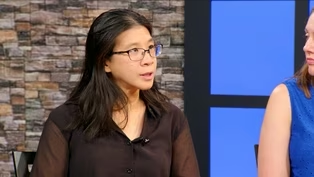
NewDiagnosing Epilepsy: Why Patient History Matters
Video has Closed Captions
A neurologist explains how patient history and EEG monitoring help diagnose epilepsy. (1m 47s)
 New
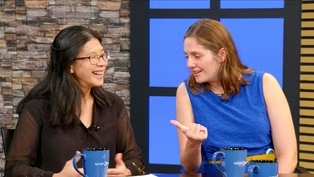
NewEveryday Habits for a Healthier Brain
Video has Closed Captions
Simple habits like sleep, exercise, hydration and nutrition can support brain health. (40s)
 New
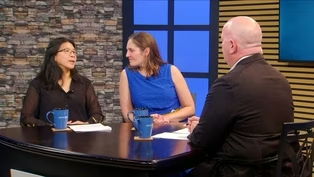
NewSeizures Don’t Always Look Like Seizures
Video has Closed Captions
Seizures can be subtle and may occur without the shaking many people expect. (1m 37s)
Providing Support for PBS.org
Learn Moreabout PBS online sponsorship New Episode
- Science and Nature

Explore scientific discoveries on television's most acclaimed science documentary series.

 New Episode









Support for PBS provided by:
Docs on Call is a local public television program presented by WTVP