Docs on Call
Seizures Don’t Always Look Like Seizures
Clip: 8/6/2026 | 1m 37sVideo has Closed Captions
Seizures can be subtle and may occur without the shaking many people expect.
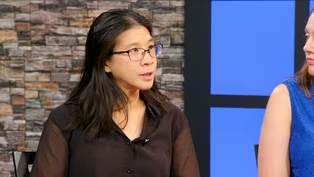
Not every seizure involves shaking or loss of consciousness. A neurologist explains how symptoms depend on where seizure activity begins and spreads in the brain, why some seizures can be difficult to recognize and when unexplained, repeated patterns of behavior or sensation should prompt medical attention.
Problems playing video? | Closed Captioning Feedback
Problems playing video? | Closed Captioning Feedback
Docs on Call is a local public television program presented by WTVP
Docs on Call
Seizures Don’t Always Look Like Seizures
Clip: 8/6/2026 | 1m 37sVideo has Closed Captions
Not every seizure involves shaking or loss of consciousness. A neurologist explains how symptoms depend on where seizure activity begins and spreads in the brain, why some seizures can be difficult to recognize and when unexplained, repeated patterns of behavior or sensation should prompt medical attention.
Problems playing video? | Closed Captioning Feedback
Where to Watch Docs on Call
Docs on Call is available to stream on pbs.org and the PBS app.
Providing Support for PBS.org
Learn Moreabout PBS online sponsorship- And when we talk about seizures, you know, I think your typical view is, okay, somebody's physically shaking, maybe they go unconscious, whatever.
Can someone have a seizure without any physical... - Oh yes.
(laughing) - Tell me about that.
- That depends on where the seizure starts and the way the seizure spreads, the symptoms can be different.
Sometimes I can be looking at you and I can be seizing.
Like you won't know.
Sometimes some other areas that don't really affect any of our day-to-day activity.
So you can see patients are talking to you and then when you don't hook up with the EEG, you don't even know that they might be having seizures all the time while you are talking to them.
So basically it's like the main thing is that what is happening, and then when you talk to like a medical attention, and then also same thing that happening like stereotyped.
Like every time this has happened, this after this, like you have this sequence that you can predict, like, "Hey, after this, I'm gonna have this."
Like kind of like this stereotyped thing that keeps going, going, then you might want to think about it.
Because unless the seizure spreads to the main region that controls your motor region, you won't see this kind of like shaking that you see on the TV.
Sometimes it can be subtle.
Sometimes like it can be like wild that you might think it's a sleep disorder, like some sort of like a sleep terror.
Like it can be mimicking a different way.
So the main thing is if you think something is going on, something doesn't make sense, something cannot be explained, visit to the medical attention person and then try to get the medical attention.
That is what I would say.
 New
NewDiagnosing Epilepsy: Why Patient History Matters
Video has Closed Captions
A neurologist explains how patient history and EEG monitoring help diagnose epilepsy. (1m 47s)
 New
NewEveryday Habits for a Healthier Brain
Video has Closed Captions
Simple habits like sleep, exercise, hydration and nutrition can support brain health. (40s)
Providing Support for PBS.org
Learn Moreabout PBS online sponsorship New Episode
- Science and Nature

Explore scientific discoveries on television's most acclaimed science documentary series.

 New Episode










Support for PBS provided by:
Docs on Call is a local public television program presented by WTVP