Docs on Call
Diagnosing Epilepsy: Why Patient History Matters
Clip: 8/6/2026 | 1m 47sVideo has Closed Captions
A neurologist explains how patient history and EEG monitoring help diagnose epilepsy.
How is epilepsy diagnosed? A neurologist explains why listening closely to a patient’s history is often the most important first step. Learn how repeated patterns can reveal possible seizures and when EEG monitoring may be used to capture brain activity and confirm what is happening.
Problems playing video? | Closed Captioning Feedback
Problems playing video? | Closed Captioning Feedback
Docs on Call is a local public television program presented by WTVP
Docs on Call
Diagnosing Epilepsy: Why Patient History Matters
Clip: 8/6/2026 | 1m 47sVideo has Closed Captions
How is epilepsy diagnosed? A neurologist explains why listening closely to a patient’s history is often the most important first step. Learn how repeated patterns can reveal possible seizures and when EEG monitoring may be used to capture brain activity and confirm what is happening.
Problems playing video? | Closed Captioning Feedback
Where to Watch Docs on Call
Docs on Call is available to stream on pbs.org and the PBS app.
Providing Support for PBS.org
Learn Moreabout PBS online sponsorship- And how, as a neurologist, do you determine if someone has epilepsy?
- So it is a few ways.
So for the neurologist, as we are, the key is the history.
Like, so we take a long time talk to the patients and get to know them first, and then I try to tease out anything in their life or events being like stereotyped.
What I mean by it, it is the same thing over and over again, that you may think that it may not be like.
Because sometimes when you have this for a long time, you don't think that is abnormal.
You think that everybody have it.
Unless you talk about it, then you're like, "Oh, I shouldn't be having that," you know, "from the beginning."
So those are the things that we tease out and then we try to get the data.
And then mainly for epilepsy is the history.
Mainly it's like when we talk to them, we don't need like big technology or things.
It's kind of like, when we talk to the patient, we can tease it out.
It's more like a clinical diagnosis, meaning that you have this kind of like clinical symptoms or signs that able to tease it out by the physician.
And then you get a real diagnosis.
Of course, some of the rare types of epilepsy is a little bit hard to tease out with a clinical.
Like for example, patients live alone.
There's no way that they can tell you right away.
So then we do what we call EEG monitoring.
So you got to hook up with those electrodes on your brain.
It's kind of like something stuck to the wall, right, in the hospital, and then you have to stay until you have a seizure that we kind of try to tease out what you have.
So it's kind of like various stages, but the first stage is that the most important thing for us is how you are feeling.
 New
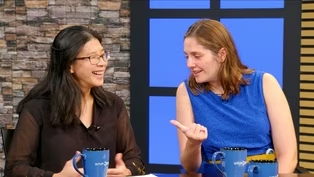
NewEveryday Habits for a Healthier Brain
Video has Closed Captions
Simple habits like sleep, exercise, hydration and nutrition can support brain health. (40s)
 New
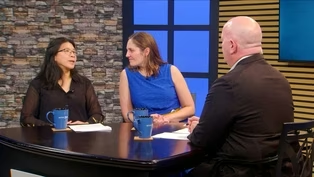
NewSeizures Don’t Always Look Like Seizures
Video has Closed Captions
Seizures can be subtle and may occur without the shaking many people expect. (1m 37s)
Providing Support for PBS.org
Learn Moreabout PBS online sponsorship New Episode
- Science and Nature

Explore scientific discoveries on television's most acclaimed science documentary series.

 New Episode









Support for PBS provided by:
Docs on Call is a local public television program presented by WTVP