
Bookstock returns, a conversation with Detroit Jazz Festival Artist-in-Residence Joe Lovano
Season 54 Episode 16 | 26m 46sVideo has Closed Captions
A preview of Bookstock and sitting down with this year’s Detroit Jazz Festival Artist-in-Residence.
It’s time for Bookstock. We’ll have details on metro Detroit’s largest used book and media sale. Plus, we’ll meet last year’s Bookstock essay contest winner. Then, we'll hear from this year's Detroit Jazz Festival Artist-in-Residence, tenor saxophonist Joe Lovano.
Problems playing video? | Closed Captioning Feedback
Problems playing video? | Closed Captioning Feedback
American Black Journal is a local public television program presented by Detroit PBS
Bookstock returns, a conversation with Detroit Jazz Festival Artist-in-Residence Joe Lovano
Season 54 Episode 16 | 26m 46sVideo has Closed Captions
It’s time for Bookstock. We’ll have details on metro Detroit’s largest used book and media sale. Plus, we’ll meet last year’s Bookstock essay contest winner. Then, we'll hear from this year's Detroit Jazz Festival Artist-in-Residence, tenor saxophonist Joe Lovano.
Problems playing video? | Closed Captioning Feedback
How to Watch American Black Journal
American Black Journal is available to stream on pbs.org and the free PBS App, available on iPhone, Apple TV, Android TV, Android smartphones, Amazon Fire TV, Amazon Fire Tablet, Roku, Samsung Smart TV, LG TV, and Vizio.
Providing Support for PBS.org
Learn Moreabout PBS online sponsorship- Just ahead on American Black Journal, it's time for Bookstock.
We'll have details on the Detroit area's largest used book and media sale.
Plus we'll meet last year's essay contest winner.
Then, it's never too early to start planning for the Detroit Jazz Festival.
We'll hear from this year's artist in residence, Joe Lovano, don't go anywhere, American Black Journal starts now.
- [Announcer] Across our Masco family of companies, our goal is to deliver better living possibilities and make positive changes in the neighborhoods where we live, work, and do business.
Masco, a Michigan company since 1929.
Support also provided by the Cynthia and Edsel Ford Fund for Journalism at Detroit PBS.
- [Announcer 2] The DTE Foundation is a proud sponsor of Detroit PBS.
Through our giving, we are committed to meeting the needs of the communities we serve statewide to help ensure a bright and thriving future for all.
Learn more at DTEFoundation.com.
- [Announcer] Also brought to you by Nissan Foundation and viewers like you.
Thank you.
(upbeat music) (upbeat music continues) (upbeat music continues) - Welcome to American Black Journal.
I'm your host, Stephen Henderson.
Metro Detroit's biggest used book and media sale is back for its 22nd year.
Bookstock returns to Laurel Park Place in Livonia for one week beginning April 26th.
More than 400,000 gently used books, DVDs, CDs, books on tape and vinyl are gonna be on sale at bargain prices.
The annual event has raised more than $3 million for literacy and education projects.
And there's also an essay contest for fourth graders in the Detroit Public Schools Community District.
Joining me now is Bookstock's honorary chairperson Neal Rubin from the Detroit Free Press, along with last year's contest winner, Skylar Chapman and her teacher, Christine Holmes from Cook STEM Academy.
Welcome to American Black Journal.
- Thank you.
- Thank you.
- Yeah, it's great to have you here.
- Thank you.
- Neal, 22 years.
That's an awful long run, but a good one.
Talk about the beginnings of Bookstock and I guess sort of how we got to this point where you're still doing it almost a quarter century later.
- Well, I got involved by writing about it and the first one was, I think it might have been at Tell 12, which tells you how long ago it was.
- (laughs) Right.
- And yeah, it was a bunch of people who decided, hey, we like this book sale that the Brandeis University Women's Alumni used to do.
Let's resurrect it, 'cause you know, the women had gotten older and the books hadn't gotten any lighter.
And so it just sort of dwindled away.
And I remember the first one, the books were all stashed in an out of business health club and they were cartons everywhere or so it seemed, you look at it now, you can't even imagine how many volunteer hours it takes to sort and categorize what's really, we say 400,000 to be safe, but it's really like half a million items up for sale.
It's just pretty astonishing.
- And talk about how you get all of that inventory.
Where does it come from?
- We start fresh every year and we just have collection days in various places.
Publicize those as best we can.
Or at bookstockmi.org and people, just this caravan of people, every time we do it drops this stuff off, which is great, 'cause to me, I mean, the whole point of this is to get books out people's basements and back in laps where a book belongs.
- Right, right, in people's homes being read to children hopefully.
- Yes.
- One of the things that's really amazing to me about this is that it's 2026 and so much of what we consume is digital.
It is on a screen and streamed from somewhere.
This is kind of old school.
And yet you could get as many items as you do to sell.
And as many people show up for those things as they do, people still really appreciate that tactile form of information.
- You know, that's a great point, a great observation.
We held meetings, I remember probably 15 years ago, wondering if, you know, if this was a used buggy whip sale.
You know, if the market was just disappearing.
But the answer is no.
The sales increase every year and people still like holding books in their hands, which is reassuring to me.
I kind of hope that translates to newspapers too.
- That's right, as old newspaper guys, we need that, right?
- Yes.
- Skylar, let's talk about the essay that you wrote last year that won the contest.
What was it about?
- The book I had read about was about a young girl named Isabella, and it was basically about her life.
- Yeah, and what about her life?
What was your favorite part of Isabella's story?
- My favorite part is about how the way she's like me and I have a personal connection to her.
- Yeah.
- And she's like me.
- Yeah, and that is that what inspired you to write about her was this idea of kind of telling your own story.
- Yes.
- Yeah.
Yeah.
Christine, and talk about the work that Skylar and the other students do at Cook STEM Academy.
- Well, I'm a fourth grade reading and social studies teacher at Cook STEM Academy.
And reading is a fundamental skill that we all need in our daily lives.
Reading supports critical thinking, writing, vocabulary.
It helps us in the real world application when it comes to filling out a job application or following directions or being able to understand what it is that you're reading.
So it's a skill that is lifelong.
It's not just when you're in school, it's something you carry throughout your whole life.
- Yeah, the work that you do with the students, like Skylar and around writing is kind of the, I guess, the next iteration of reading, right?
- Yes.
- You learn to read and then you put it to work.
Talk about how something like this essay contest, I guess, kind of fits into the curriculum there at Cook.
- Well, in our curriculum, which is EL for Education, there is a reading component and there's also a writing component where they're writing about what they read, whether it's informational text or historical fiction.
And it can be a struggle getting students to write.
So it's something that we practice every day.
Because the more you read, the more you write, the better you become at it.
- Yeah.
Yeah.
Do you find that the competition of the screen that I was talking about interferes with the work in the school, with both reading and writing?
- It can be.
It can be.
I grew up reading books.
My mom took me to the library twice a month.
So it was something that I enjoyed.
And so, in my own classroom, I have a vast library of picture books, chapter books, books from different cultures to foster their love for reading and their imagination, which in turn will show when it comes to their writing.
And I do believe that an actual book- - There's something magical about it.
- Magical, yes.
Very magical about having a book in your hand, turning the pages as opposed to looking on your cell phone.
I feel like it's more authentic when you have that book in front of you.
- Yeah, yeah.
- You can get lost in it.
- I think all of us can kind of remember that first book that we took from our parents, right.
It had our parents reading to us and then said, no, I wanna read it myself, right.
There's that, that moment where you're like, I want to be in charge of this.
And I think that's how we all kind of fall in love with books.
Skylar, can you think of some books that you really enjoy, either from class or that you have at home?
- I do enjoy some books.
I really don't like reading but, I favor writing more.
- Oh, you like to write more than read.
That is a good thing.
Maybe you'll grow up to be a writer.
Is that something you think about?
- Yes.
- Yeah.
Yeah, that would be great.
What's the future of Bookstock?
I mean, 22 years, you're coming up on a quarter century.
Do you think much about what comes next?
- Well, you know, we try to think long term at the same time, we have to think short term.
As soon as this one's over, we'll start thinking about the next one.
- Yeah.
- We are starting to think about line of succession.
- Yeah.
- It's all volunteer, but you know, we need to bring more people in.
So if you're out there with an interest, you know, just sort of younger people to keep this thing going.
We haven't lost interest or enthusiasm, but, you know, little youth never hurts in a situation like this.
- Right, to keep it going.
- So that's a focus.
But I think people are gonna continue to want to read books to hold them in their laps, like you were saying.
And I, you know, you put it wonderfully.
You get lost in a book if you're reading on a screen, at least to me, particularly if it's a phone, there are so many distractions.
There's things lighting up, there's things demanding your attention.
And to me, Bookstock sort of reinforces the whole idea that reading isn't something you have to do, it's something that you get to do.
- That you get joy out of, right?
- Yes.
- Yeah.
Can you talk about some of the other education projects that are beneficiaries of Bookstock, other than the school program?
- Sure, Oakland Literacy Council is one, and one of the things they do that I just love is adult education.
There are a staggering number of adults who can't read at all.
Or can't read well enough to make it worthwhile.
And so they do tutoring through Oakland Literacy Council, creating, I hope, future customers for Bookstock.
Another one I really like involves prisoners up north.
And it's a program that allows people who are incarcerated to read bedtime stories.
To read and record bedtime stories so that wherever their kids are, usually downstate, you know, but outside the prison system, they can have that parent read bedtime stories.
That one, I just get a glow every time I talk about that one.
- Yeah.
Yeah.
And I mean, the idea of, again, kind of feeding the, not just the ability to read, but the thirst for reading, for words and stories is such a powerful idea behind Bookstock.
- Oh yeah, and it is, you know, we're kindling or rekindling or keeping the furnace burning on that enthusiasm.
And you look at the two of us, you know, I learned to read and write by kindergarten, and I've gotten by in life with no other marketable skills.
- That's right.
No other actual skills, right?
- Can't do anything else.
You can at least host a show.
So you- - This is about words and ideas too, right?
- Yes, it's true.
You know, we are so lucky.
And I'm guessing both of us had parents who just routinely read to us and got ingrained that idea that, wow, this is a great thing I need to do more of it.
- Yeah.
Yeah.
All right, so Neal and Christine, I'm gonna ask you about your favorite books as we close the interview.
What are books that you just can't put down?
- "Love in the Driest Season," by a fellow named Neely Tucker.
He was a "Washington Post" correspondent.
- Yes, I remember Neely.
- Yes, of course, he was at the Free Press.
- Yeah.
- It's about he and his wife finding a baby in an orphanage in Zimbabwe when he was the African co correspondent.
Everything it took to bring her home to adopt her, which they ultimately did.
And I get weepy every time I read it.
And then I find myself reading it again.
- Yeah, that's a great name from the past, Neely Tucker.
I remember him really well.
Christine, what books can't you put down?
- I like books that are mystery.
I'm a mystery person, so I like mystery books.
I do like a little drama in my books, so one of my favorite auth authors is Sister Souljah.
She wrote a book called "The Coldest Day in Winter," and that was one of my favorite books.
- Yeah,-yeah.
- Really loved it.
- That's great.
Wow.
Well congratulations on 22 years of Bookstock, and thanks to all of you for being here on the American Black Journal.
- Thank you.
- Thank you.
- Up next saxophonist, Joe Lovano is gonna talk about his role in this year's Detroit Jazz Festival.
But first, here's a clip from a 1991 Detroit Black Journal conversation about literacy with famous entrepreneur Wally Amos.
- So how did you get involved with literacy?
- It was 1979, I believe.
And I approached Literacy Volunteers of America and suggested to them that I become their national spokesperson.
Having discovered that illiteracy was a problem and I thought that I could help them promote literacy because I was on talk shows and traveling and doing all that kind of stuff.
And I wanted to give something back, you know, I was looking for a constructive way to use being famous, and I was also looking for a way to promote my cookies, you know, and I saw that as satisfying all of those needs.
And so they accepted my offer.
And God, in the last 11 years, I've crisscrossed the United States so many times at my own expense.
It hasn't cost LVA one penny, helped 'em raise money.
I helped start the LVA affiliate here in Detroit.
- Well, that's a good time to bring in our two guests.
(laughing) That's a great segue to welcome Ann Merritt and Deborah Flowers, both from the local branch of the Literacy Volunteers of America.
Welcome to the program.
- Thank you.
- So I know that that is a major thrust during the month of February and Channel 56 will be involved as well.
But Ann, maybe you can tell me about the local chapter and what kinds of things you do here locally.
- Well, to get back to the history, he's right.
Had it not been for him, we wouldn't exist because he came here to speak and realized that despite the enormity of the problem, there was no affiliate here.
So he talked to Reverend Williamson, the pastor at Detroit Unity Temple, and suggested that he would contribute and he'd get friends of his to contribute.
And they called LVA national and David could recruit within the church, which he did.
And they did have LVA national come in and train a group of 35.
And that was the beginning in November of 1984.
- Wow.
- So thanks to Wally Amos and Reverend David Williams in Detroit Unity Temple, we began.
- So how has it grown since then, Deborah?
- Well, we've grown from 35 tutors to over 330 at the present time.
- Wow.
- But the real tragedy is that there are approximately 600 readers on our waiting list awaiting placement.
- Waiting.
- Right.
- People that want to and have stepped forward.
And that's tough in the first place for an adult to admit I have a problem and I want help, and we don't have enough people to help right now.
- No, we don't, so we need more than 330.
Even though the program has grown, it needs to continue to grow.
- How do you define literacy?
- How do we define it?
- Yeah.
Or illiteracy.
Maybe I should clarify to turn it around, yeah.
- Illiteracy would be the inability to function in the everyday worker day world or living world.
Not being able to read the newspaper, cans in the supermarket, coupons in the newspaper, bus schedules, basic things.
There are a lot of more sophisticated definitions, but the more practical worker day everyday definition is the one that we go by at Literacy Volunteers of America.
If a person feels that they need help with their reading and they're not able to read those types of items, the newspaper, or if they feel that they're not comprehending what they have read, then we will try to assist them in some way.
- No, no, we won't try, we will assist.
- We will.
- We will.
- We will assist it.
- True.
Thank you.
(laughing) - We will, we will.
- The world's largest free jazz festival.
It's gonna take place on Detroit's Heart Plaza over the Labor Day weekend.
This year's Detroit Jazz Festival artist in residence is saxophonist Joe Lovano.
Last month, Lovano held a workshop for Wayne State University music students and he sat down for a conversation with Detroit PBS contributor, John Penney of 90.9 WRCJ.
(jazz music) (jazz music continues) - I am here today with the artist in residence for the 47th Annual Detroit Jazz Festival.
Joe Lovano, it's a pleasure and an honor to be here with you.
- Thank you John, for me as well.
- Joe grew up in Cleveland in a very musical family.
Father being Big T, Tony who played the saxophone and his brothers, I guess were also musicians.
You picked up a saxophone when you were six.
It was an alto.
You had to grow into the tenor and your first teacher was your father.
And one of my favorite stories that you told once was how you were one day practicing scales and your father came in and said, "Play them like they're melodies."
- And this one day I'm playing, I'm going up and down the bars, you know, it's like an exercise.
And he's listening, and he was upstairs, he wasn't giving me a lesson at the time.
I was in the basement practice, he comes down with his horn and he said, "Oh yeah, Joey, yeah, mm-hm" And then he took a major scale and he just played (vocalizing).
(vocalizing continues) You know, he made it sound like a song.
The same notes of the same sequence that I was running around the horn, you know?
And man, that changed everything, and then he just split.
(jazz music) - You know, you again teach at Berkeley and you had a workshop with the kids here at Wayne State today.
What do you want them to take away from this workshop?
- Well, I just like the stress all the time about living in the library, the sounds and spirits of the masters on every instrument, no matter what your instrument is.
The more you do that, you know where people are from, who they came up with, how old they were, certain record you love or whatever, you know, it's up to you to create how you discover things.
You know what I mean?
What influences and how your influences can take shape for your artistry.
- The career has just been astounding and it's been a real pleasure to listen.
And you have really deep roots in Detroit.
- First of all, I'd just like to say it's a blessing to live in the world of music and put some ensembles together through the years and develop within the embrace of some amazing masters of the music.
And quite a few of them were Detroit Masters.
The Jones family, Hank Jones, Thad Jones, Elvin Jones.
I had a chance to be a part of the Thad Jones, Mel Lewis Band, and then the Mel Lewis Band when Thad went to Copenhagen, played in Elvin Jones Jazz Machine and toured Europe with him in 1987.
And then he recorded with me on one of my blue note releases, "Trio fascination" with Dave Holland on bass.
And then Hank Jones documented some recordings on "Blue Note."
- You first came to Detroit, I think in '74, I believe.
- 1974 I got the call from Dr.
Lonnie Smith, who was living around the corner from Baker's Keyboard Lounge.
He was looking for a tenor player and played in Cleveland with Lou Donaldson and had heard about me and someone gave him my family phone number and I got the call.
So I flew to Detroit and started to play with him, and that led to a lot of everything.
- And Jason Moran talked about a particular Detroit sound.
He described it as like the Detroit Bounce.
What is it?
Is there a Detroit well feeling?
- Well, the way I heard everything was through, it was a real like feeling in the beat and the harmony and the execution of ideas that were personal.
There was a certain sweetness in the way cats played also, it wasn't like an aggressive kind of approach.
(jazz music) - As the artist in residence this year, tell people what you're gonna bring to the festival.
- I'm gonna present my current quartet called the Paramount Quartet with Julian Lage on guitar, brilliant young guitarist, Asante Santi Debriano on bass, who played a lot with Archie Shep and Randy Weston and others, and Will Calhoun on drums, who's an amazing, explosive, beautiful musician.
- What makes it the Detroit Jazz Festival?
What's unique?
I mean, is it unique?
- Well, it's amazing to have like such an incredible venues to play at and have the audience and have it be a free open festival.
It's one of the most beautiful opportunities for all of us that are on tour all the time to see each other and hear each other and feel the beautiful space and the audiences here in Detroit that are so hip because of the history of the music here.
- That's gonna do it for us this week.
You can find out more about our guests at americanblackjournal.org, and you can connect with us anytime on social media.
Take care, and we'll see you next time.
(upbeat music) (upbeat music continues) - [Announcer] Across our Masco family of companies, our goal is to deliver better living possibilities and make positive changes in the neighborhoods where we live, work, and do business.
Masco, a Michigan company since 1929.
Support also provided by the Cynthia and Edsel Ford Fund for Journalism at Detroit PBS.
- [Announcer 2] The DTE Foundation is a proud sponsor of Detroit PBS.
Through our giving, we are committed to meeting the needs of the communities we serve statewide to help ensure a bright and thriving future for all.
Learn more at DTEFoundation.com.
- [Announcer] Also brought to you by Nissan Foundation and viewers like you.
Thank you.
(bright music)
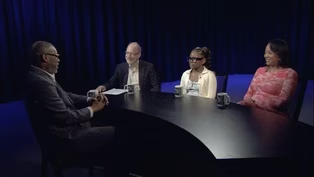 New
NewBookstock is back in metro Detroit for its 22nd year
Video has Closed Captions
Clip: S54 Ep16 | 13m 15s | More than 400,000 gently used books, DVDs, CDs, books on tape and vinyl will be on sale. (13m 15s)
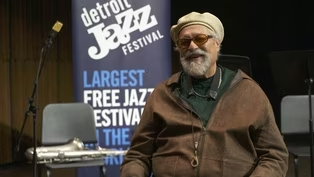 New
NewSaxophonist Joe Lovano discusses his role as this year’s Detroit Jazz Festival Artist-in-Residence
Video has Closed Captions
Clip: S54 Ep16 | 6m 39s | Joe Lovano sat down for a conversation with Detroit PBS contributor John Penney of 90.9 WRCJ. (6m 39s)
Providing Support for PBS.org
Learn Moreabout PBS online sponsorship
- News and Public Affairs

Top journalists deliver compelling original analysis of the hour's headlines.

- News and Public Affairs

FRONTLINE is investigative journalism that questions, explains and changes our world.











Support for PBS provided by:
American Black Journal is a local public television program presented by Detroit PBS