
Bookstock is back in metro Detroit for its 22nd year
Clip: Season 54 Episode 16 | 13m 15sVideo has Closed Captions
More than 400,000 gently used books, DVDs, CDs, books on tape and vinyl will be on sale.
Bookstock, metro Detroit's largest used book and media sale, takes place at Laurel Park Place from April 26 to May 3. Host Stephen Henderson sits down with Bookstock Honorary Chairperson Neal Rubin from the Detroit Free Press, along with last year's Bookstock essay contest winner, Skylar Chapman, and her teacher Kristeen Holmes.
Problems playing video? | Closed Captioning Feedback
Problems playing video? | Closed Captioning Feedback
American Black Journal is a local public television program presented by Detroit PBS
Bookstock is back in metro Detroit for its 22nd year
Clip: Season 54 Episode 16 | 13m 15sVideo has Closed Captions
Bookstock, metro Detroit's largest used book and media sale, takes place at Laurel Park Place from April 26 to May 3. Host Stephen Henderson sits down with Bookstock Honorary Chairperson Neal Rubin from the Detroit Free Press, along with last year's Bookstock essay contest winner, Skylar Chapman, and her teacher Kristeen Holmes.
Problems playing video? | Closed Captioning Feedback
How to Watch American Black Journal
American Black Journal is available to stream on pbs.org and the free PBS App, available on iPhone, Apple TV, Android TV, Android smartphones, Amazon Fire TV, Amazon Fire Tablet, Roku, Samsung Smart TV, LG TV, and Vizio.
Providing Support for PBS.org
Learn Moreabout PBS online sponsorshipMetro Detroit's biggest used book and media sale is back for its 22nd year.
Bookstock returns to Laurel Park Place in Livonia for one week beginning April 26th.
More than 400,000 gently used books, DVDs, CDs, books on tape and vinyl are gonna be on sale at bargain prices.
The annual event has raised more than $3 million for literacy and education projects.
And there's also an essay contest for fourth graders in the Detroit Public Schools Community District.
Joining me now is Bookstock's honorary chairperson Neal Rubin from the Detroit Free Press, along with last year's contest winner, Skylar Chapman and her teacher, Christine Holmes from Cook STEM Academy.
Welcome to American Black Journal.
- Thank you.
- Thank you.
- Yeah, it's great to have you here.
- Thank you.
- Neal, 22 years.
That's an awful long run, but a good one.
Talk about the beginnings of Bookstock and I guess sort of how we got to this point where you're still doing it almost a quarter century later.
- Well, I got involved by writing about it and the first one was, I think it might have been at Tell 12, which tells you how long ago it was.
- (laughs) Right.
- And yeah, it was a bunch of people who decided, hey, we like this book sale that the Brandeis University Women's Alumni used to do.
Let's resurrect it, 'cause you know, the women had gotten older and the books hadn't gotten any lighter.
And so it just sort of dwindled away.
And I remember the first one, the books were all stashed in an out of business health club and they were cartons everywhere or so it seemed, you look at it now, you can't even imagine how many volunteer hours it takes to sort and categorize what's really, we say 400,000 to be safe, but it's really like half a million items up for sale.
It's just pretty astonishing.
- And talk about how you get all of that inventory.
Where does it come from?
- We start fresh every year and we just have collection days in various places.
Publicize those as best we can.
Or at bookstockmi.org and people, just this caravan of people, every time we do it drops this stuff off, which is great, 'cause to me, I mean, the whole point of this is to get books out people's basements and back in laps where a book belongs.
- Right, right, in people's homes being read to children hopefully.
- Yes.
- One of the things that's really amazing to me about this is that it's 2026 and so much of what we consume is digital.
It is on a screen and streamed from somewhere.
This is kind of old school.
And yet you could get as many items as you do to sell.
And as many people show up for those things as they do, people still really appreciate that tactile form of information.
- You know, that's a great point, a great observation.
We held meetings, I remember probably 15 years ago, wondering if, you know, if this was a used buggy whip sale.
You know, if the market was just disappearing.
But the answer is no.
The sales increase every year and people still like holding books in their hands, which is reassuring to me.
I kind of hope that translates to newspapers too.
- That's right, as old newspaper guys, we need that, right?
- Yes.
- Skylar, let's talk about the essay that you wrote last year that won the contest.
What was it about?
- The book I had read about was about a young girl named Isabella, and it was basically about her life.
- Yeah, and what about her life?
What was your favorite part of Isabella's story?
- My favorite part is about how the way she's like me and I have a personal connection to her.
- Yeah.
- And she's like me.
- Yeah, and that is that what inspired you to write about her was this idea of kind of telling your own story.
- Yes.
- Yeah.
Yeah.
Christine, and talk about the work that Skylar and the other students do at Cook STEM Academy.
- Well, I'm a fourth grade reading and social studies teacher at Cook STEM Academy.
And reading is a fundamental skill that we all need in our daily lives.
Reading supports critical thinking, writing, vocabulary.
It helps us in the real world application when it comes to filling out a job application or following directions or being able to understand what it is that you're reading.
So it's a skill that is lifelong.
It's not just when you're in school, it's something you carry throughout your whole life.
- Yeah, the work that you do with the students, like Skylar and around writing is kind of the, I guess, the next iteration of reading, right?
- Yes.
- You learn to read and then you put it to work.
Talk about how something like this essay contest, I guess, kind of fits into the curriculum there at Cook.
- Well, in our curriculum, which is EL for Education, there is a reading component and there's also a writing component where they're writing about what they read, whether it's informational text or historical fiction.
And it can be a struggle getting students to write.
So it's something that we practice every day.
Because the more you read, the more you write, the better you become at it.
- Yeah.
Yeah.
Do you find that the competition of the screen that I was talking about interferes with the work in the school, with both reading and writing?
- It can be.
It can be.
I grew up reading books.
My mom took me to the library twice a month.
So it was something that I enjoyed.
And so, in my own classroom, I have a vast library of picture books, chapter books, books from different cultures to foster their love for reading and their imagination, which in turn will show when it comes to their writing.
And I do believe that an actual book- - There's something magical about it.
- Magical, yes.
Very magical about having a book in your hand, turning the pages as opposed to looking on your cell phone.
I feel like it's more authentic when you have that book in front of you.
- Yeah, yeah.
- You can get lost in it.
- I think all of us can kind of remember that first book that we took from our parents, right.
It had our parents reading to us and then said, no, I wanna read it myself, right.
There's that, that moment where you're like, I want to be in charge of this.
And I think that's how we all kind of fall in love with books.
Skylar, can you think of some books that you really enjoy, either from class or that you have at home?
- I do enjoy some books.
I really don't like reading but, I favor writing more.
- Oh, you like to write more than read.
That is a good thing.
Maybe you'll grow up to be a writer.
Is that something you think about?
- Yes.
- Yeah.
Yeah, that would be great.
What's the future of Bookstock?
I mean, 22 years, you're coming up on a quarter century.
Do you think much about what comes next?
- Well, you know, we try to think long term at the same time, we have to think short term.
As soon as this one's over, we'll start thinking about the next one.
- Yeah.
- We are starting to think about line of succession.
- Yeah.
- It's all volunteer, but you know, we need to bring more people in.
So if you're out there with an interest, you know, just sort of younger people to keep this thing going.
We haven't lost interest or enthusiasm, but, you know, little youth never hurts in a situation like this.
- Right, to keep it going.
- So that's a focus.
But I think people are gonna continue to want to read books to hold them in their laps, like you were saying.
And I, you know, you put it wonderfully.
You get lost in a book if you're reading on a screen, at least to me, particularly if it's a phone, there are so many distractions.
There's things lighting up, there's things demanding your attention.
And to me, Bookstock sort of reinforces the whole idea that reading isn't something you have to do, it's something that you get to do.
- That you get joy out of, right?
- Yes.
- Yeah.
Can you talk about some of the other education projects that are beneficiaries of Bookstock, other than the school program?
- Sure, Oakland Literacy Council is one, and one of the things they do that I just love is adult education.
There are a staggering number of adults who can't read at all.
Or can't read well enough to make it worthwhile.
And so they do tutoring through Oakland Literacy Council, creating, I hope, future customers for Bookstock.
Another one I really like involves prisoners up north.
And it's a program that allows people who are incarcerated to read bedtime stories.
To read and record bedtime stories so that wherever their kids are, usually downstate, you know, but outside the prison system, they can have that parent read bedtime stories.
That one, I just get a glow every time I talk about that one.
- Yeah.
Yeah.
And I mean, the idea of, again, kind of feeding the, not just the ability to read, but the thirst for reading, for words and stories is such a powerful idea behind Bookstock.
- Oh yeah, and it is, you know, we're kindling or rekindling or keeping the furnace burning on that enthusiasm.
And you look at the two of us, you know, I learned to read and write by kindergarten, and I've gotten by in life with no other marketable skills.
- That's right.
No other actual skills, right?
- Can't do anything else.
You can at least host a show.
So you- - This is about words and ideas too, right?
- Yes, it's true.
You know, we are so lucky.
And I'm guessing both of us had parents who just routinely read to us and got ingrained that idea that, wow, this is a great thing I need to do more of it.
- Yeah.
Yeah.
All right, so Neal and Christine, I'm gonna ask you about your favorite books as we close the interview.
What are books that you just can't put down?
- "Love in the Driest Season," by a fellow named Neely Tucker.
He was a "Washington Post" correspondent.
- Yes, I remember Neely.
- Yes, of course, he was at the Free Press.
- Yeah.
- It's about he and his wife finding a baby in an orphanage in Zimbabwe when he was the African co correspondent.
Everything it took to bring her home to adopt her, which they ultimately did.
And I get weepy every time I read it.
And then I find myself reading it again.
- Yeah, that's a great name from the past, Neely Tucker.
I remember him really well.
Christine, what books can't you put down?
- I like books that are mystery.
I'm a mystery person, so I like mystery books.
I do like a little drama in my books, so one of my favorite auth authors is Sister Souljah.
She wrote a book called "The Coldest Day in Winter," and that was one of my favorite books.
- Yeah,-yeah.
- Really loved it.
- That's great.
Wow.
Well congratulations on 22 years of Bookstock, and thanks to all of you for being here on the American Black Journal.
- Thank you.
- Thank you.
 New
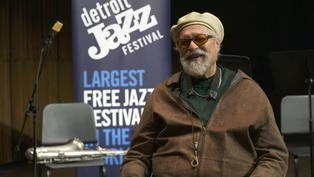
NewSaxophonist Joe Lovano discusses his role as this year’s Detroit Jazz Festival Artist-in-Residence
Video has Closed Captions
Clip: S54 Ep16 | 6m 39s | Joe Lovano sat down for a conversation with Detroit PBS contributor John Penney of 90.9 WRCJ. (6m 39s)
Providing Support for PBS.org
Learn Moreabout PBS online sponsorship
- News and Public Affairs

Top journalists deliver compelling original analysis of the hour's headlines.

- News and Public Affairs

FRONTLINE is investigative journalism that questions, explains and changes our world.











Support for PBS provided by:
American Black Journal is a local public television program presented by Detroit PBS