
Washington Week with The Atlantic full episode, 3/13/26
3/13/2026 | 24m 10sVideo has Closed Captions
Full Washington Week with the Atlantic broadcast from March 13, 2026.
The U.S. war against Iran is moving fast and America's footprint in the Middle East is expanding. Plus, as the conflict enters its third week, the global energy market faces catastrophic consequences. Join guest moderator Vivian Salama, Steve Inskeep of NPR, Mark Mazzetti of The New York Times, Felicia Schwartz of Politico and Nancy Youssef of The Atlantic to discuss this and more.
Problems playing video? | Closed Captioning Feedback
Problems playing video? | Closed Captioning Feedback
Major funding for “Washington Week with The Atlantic” is provided by Consumer Cellular, Otsuka, Kaiser Permanente, the Yuen Foundation, and the Corporation for Public Broadcasting.
Washington Week with The Atlantic full episode, 3/13/26
3/13/2026 | 24m 10sVideo has Closed Captions
The U.S. war against Iran is moving fast and America's footprint in the Middle East is expanding. Plus, as the conflict enters its third week, the global energy market faces catastrophic consequences. Join guest moderator Vivian Salama, Steve Inskeep of NPR, Mark Mazzetti of The New York Times, Felicia Schwartz of Politico and Nancy Youssef of The Atlantic to discuss this and more.
Problems playing video? | Closed Captioning Feedback
How to Watch Washington Week with The Atlantic
Washington Week with The Atlantic is available to stream on pbs.org and the free PBS App, available on iPhone, Apple TV, Android TV, Android smartphones, Amazon Fire TV, Amazon Fire Tablet, Roku, Samsung Smart TV, and Vizio.
Buy Now
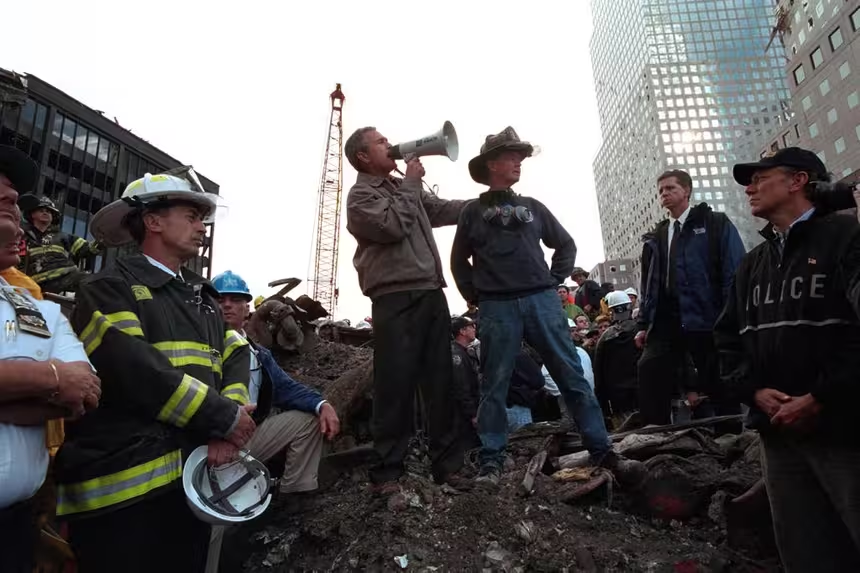
10 big stories Washington Week covered
Washington Week came on the air February 23, 1967. In the 50 years that followed, we covered a lot of history-making events. Read up on 10 of the biggest stories Washington Week covered in its first 50 years.Providing Support for PBS.org
Learn Moreabout PBS online sponsorshipVivian Salama: The war with Iran is moving fast and growing deadlier.
As the conflict enters its third week, it's having catastrophic consequences on global energy markets, and the new ayatollah shows no signs of backing down.
Tonight, as surprising twist, why Iran may have leverage in this fight, next.
Good evening and welcome to Washington Week.
I'm Vivian Salama in tonight for Jeffrey Goldberg.
The U.S.-Israel war against Iran is moving fast and America's footprint in the Middle East is expanding.
President Trump announced moments ago that the U.S.
launched new airstrikes this time at Iran's Kharg Island.
The Pentagon earlier today said it's sending more warships and more military personnel to the region.
It's been a busy day, so let's get straight to the panel.
Joining us tonight, Steve Inskeep, the host of NPR's Morning Edition, Mark Mazzetti is a Washington correspondent at The New York Times, Felicia Schwartz is a diplomatic correspondent for Politico, and Nancy Youssef is a staff writer and a Pentagon correspondent at The Atlantic.
Thank you all for joining us, busy, busy day.
Nancy, I'm going to start with you because the president took to Truth Social just before we came on air, and he announced that the United States Central Command executed one of the most powerful bombing raid in the history of the Middle East and totally obliterated every military target in Iran's crown jewel, Kharg Island.
He goes on to talk about how they spared the island's oil infrastructure, but that he had -- he reserved the right to do so.
Explain the significance of this strike.
Nancy Youssef, Staff Writer, The Atlantic: So, Kharg Island is only about one third of the size of Manhattan, but don't let that small size mislead you.
It is the cornerstone of the Iranian economy.
90 percent of its oil exports come out of that island.
And so the strikes on it have two big impacts, both military and economic.
Let's start with economic.
By striking the island, you potentially take oil off of the market, raising already rising Brent Crude prices at a time when there's a lot of anxiety about oil reaching $150 or even $200 a barrel.
And, militarily, the Iranians have threatened that if this island was attacked, they would make it hard for oil to leave the region threatening to attack oil production and oil facilities in Gulf partner, something they've already done.
But there's the threat that they would ramp up those strikes with this attack by the United States, Vivian Salama: And also a location where there's significant Islamic Revolutionary Guard facilities.
You have -- I mean it's nicknamed Forbidden Island due to its strict security and restricted access there.
And so it seems they're going after the military targets for now, based on the president's Truth Social post.
Nancy Youssef: Right.
I mean, as you point out, it has a military value for the IRGC, but it's also a source of revenue for the IRGC as well.
And as you note, it's in the Strait of Hormuz, which we've been talking about all week, its strategic importance to oil exports going through there for the whole world economy.
So, the fact that there's more instability in such a vital part of the strait only adds to, I think, global anxiety about the pace of the war and the effects it could have on the energy markets.
Vivian Salama: Absolutely.
And we're going to talk more about the Strait of Hormuz.
But, Felicia, the president has been basically proclaiming victory even as we continue kind of into the third week of this conflict.
Why then would he go over after Kharg now?
What's the significance of the timing of this particularly?
Felicia Schwartz, Diplomatic Correspondent, Politico: So, what we've seen is that Iran has very strategically taken a lot of the leverage, a lot of the power back in this conflict, like Nancy said, with -- by basically essentially shutting off the Strait of Hormuz, where about a fifth of the world's oil and energy and gas trade moves through.
And so he wants to take some of that leverage back.
He wants to say to the Iranians, we can -- you know, they are still able to move a little bit of traffic through the Strait of Hormuz.
He wants to be able to say, this is -- you know, if we bomb your energy infrastructure totally, that will completely -- it will have huge economic impacts for the Iranian economy.
So, he wants to see if he can kind of get the Iranians to allow more traffic through the strait.
I'm not really sure that's going to work, but he wants to kind of change the balance of power.
Vivian Salama: And all of this, of course, is coming as the president announces that more troops and more warships are going to the region as well.
What do we know about that?
Steve Inskeep, Host, NPR: It strikes me that the administration is escalating again and again and again in a way that also threatens the United States.
As Nancy was talking, I was thinking about that.
If you're striking the Persian Gulf, if you're raising more uncertainty about oil supplies, Iranian oil tankers are among the few that are getting through the Persian Gulf right now.
What you effectively do is raise the price of oil and put further burden on the U.S.
economy.
Now, you are correct that the military appears to be moving another Marine Expeditionary Unit to the Gulf.
I've traveled with them in the past.
It's a couple thousand or more U.S.
Marines along with helicopters and airplanes and ships and a lot of equipment.
They're extremely powerful.
But a couple thousand Marines is not very many in the context of a country like Iran.
This is something you could imagine sending them to take over an island in the Strait of Hormuz.
I don't know what the objective is, or if one has even been ordered.
But the president is clearly comfortable escalating in a way that entails greater risk for Iran but also greater risk for the United States and the world.
Vivian Salama: Nancy, have we gotten specifics on the numbers of troops that are going specifically?
Nancy Youssef: So, MEU, as Marines refer to it, has two components, Marines and sailors.
This MEU has three ships, about 2,400 Marines, and then another 2000 sailors or so, so 4,000 in all.
They're kind of seen as the 911 of force of the military in that they can go from ship to shore quickly.
They're trained for a multitude of missions.
So, you could see - - we might -- we've seen them in the past do things like humanitarian missions, evacuations, but they could also move, as you note, onto an island.
They could also support any sort of ground offensive in terms of that sort of initial steps, but we haven't been told what they'll do.
I should also note that they are coming from Asia on Amphibs, which are very slow moving ships.
So, it'll take somewhere between ten days and two weeks for them to be in the region.
So, that tells us that perhaps they're being put in place to create options down the road in this conflict.
Vivian Salama: Okay.
So, that's something definitely to watch.
So, Mark, President Trump went on Brian Kilmeade's podcast this week and he said that he would feel it in his bones when this conflict is over.
Beyond that, what do we know or what clarity have we gotten from the administration on what an end to this conflict actually looks like?
What would constitute a victory?
Mark Mazzetti, Washington Correspondent, The New York Times: Well, it depends on the day or the hour or the minute or whatever interview that the president takes with a different reporter, right?
Vivian Salama: Right.
Mark Mazzetti: What we've seen over the last two weeks is the senior administration officials, like Marco Rubio, have gone out every day and said there are very clear objectives.
We have three or four, depending on the day, to destroy the missile capacity, the Navy, Iran's ability to use proxies around the region.
And what constitutes victory is decimating these four objectives, right?
But then the president comes out and says things like unconditional surrender.
We will have -- you know, the Iranian regime will collapse.
We will have -- you know, the United States and President Trump will be picking the new leader, right?
So, it has depended on, you know, the whims of the president.
I can say that the administration is still trying to limit the objectives and not make this look like an endless war, but it's been a mess in terms of the messaging of what this actually kooks like, what an end game actually looks like.
Vivian Salama: One of the things, Steve, that the administration has insisted is that Iran is essentially cornered now.
And even as the new supreme leader, Mojtaba Khamenei, has come out and vowed defiance, they say that they are very much cornered.
But at the same time, we're hearing of mines being placed in the Strait of Hormuz that is severely disrupting the shipping lane in ways we've never seen before.
Does Iran have a surprising amount of leverage in this conflict to disrupt the global markets in a way that we never really anticipated?
Steve Inskeep: Surprising, I don't know.
I think analysts were aware that Iran could close the Strait of Hormuz.
And, in fact, Defense Secretary Pete Hegseth, Secretary of War, if you like, Pete Hegseth, said in a news conference this week that, of course, they had plans for this.
Of course, they were aware that Iran could do this.
Nevertheless, Iran seems to have had considerable effect.
And you mentioned the mining.
I don't know if they're going to succeed in that.
I don't know if they have done it, but they haven't really had to do it because the shipping is largely stopped.
You can't ensure a ship that is going to go through the Persian Gulf.
And enough of them have been struck that they have a problem.
And this raises a question for me.
The president said, I believe, to Axios that he could decide when the war ends.
I can quit whenever I want.
That's not a direct, quote, but, effectively, that's what he said.
And it does raise a question as to whether Iran is willing to go along with that.
In the 12-day war last year, the United States was able to say, we're done, we've achieved our objective, Iran will do a retaliatory strike and it's going to be over.
I don't know if that's going to be the case.
This time because Iran has played this card that has threatened to play for decades and now it's done it and countries around the world are suffering.
Mark Mazzetti: Can I just add?
Vivian Salama: Yes, please.
Mark Mazzetti: Iran is behaving very differently than they did last June, and that has surprised some people in the White House.
As you said, it sort of went according to a certain plan where there were attacks, there was one night of strikes by the U.S., Iran retaliated, it was over, right?
Iran seems to think this is a far more existential conflict.
And so therefore they're using the leverage that they didn't use the last time, specifically economic leverage, and they're also hitting strikes around the Gulf.
And it also raises the question of even when the war's over, they will have this leverage that they've already shown that they're willing to use, which gives them a certain amount of power in the future.
Vivian Salama: I mean, I hear you saying -- agreeing with Mark, Felicia.
Do you feel like the White House was surprised?
And if so, why?
We know that, for example, they were talking to Israel quite a bit in the lead up to this conflict.
You were based in Israel years ago and you know the country well.
What's your sense of the information that they were getting and how much of a reality check they had going into this conflict?
Felicia Schwartz: I think, you know, there were Arab diplomats flooding Washington, meeting any official they could meet with, saying it's going to be different this time.
Iran needs to change the deterrence calculation.
They're going to respond more forcefully.
I think there's been plenty of reporting suggesting that they did have -- you know, they should have had access to intelligence showing this kind of thing.
But I think they -- Trump has -- is kind of a vibes president.
He's really taken a lot of lessons from what happened in Venezuela, what happened in the 12-day war.
I think Iran and its history and its people is a very different situation than what we saw in Venezuela.
And I think, you know, some of it was like the experts are always wrong, the blob always tells us we can't, you know, this joking, diminutive term people use for the foreign policy establishment, that, you know, they told us we couldn't move the embassy in Jerusalem.
It was fine.
Everyone said the 12-day war was going to be a disaster, Venezuela was going to be a disaster.
So, I think, you know, Trump has been able to do things that everyone told him he couldn't do.
And I think some of it was confirmation bias.
It's a small circle of people.
And I think, you know, like Steve Witkoff before the talk started, he went on Fox and he said, we're just really surprised the Iranians won't surrender, I think that's a big misunderstanding of the regime and how they operate.
So, I think it was a bit of just a misread of the situation.
Vivian Salama: Nancy, you wrote a story this week, which was entitled Iran has -- the Iran war has four stages and we're in the second.
Explain to us what those stages look like.
Because it also suggests maybe there is an endgame in sight.
So -- Nancy Youssef: There's one on paper anyway.
Vivian Salama: Yes.
Nancy Youssef: I wanted to write it too, because I think people were asking what the timeline is and what are we seeing.
And so in terms of military strategy, it starts with the initial strikes, the initial attacks that we saw followed by sort of trying to control the territory dominate -- when the shift that you've seen in this is rather than using missiles, we're seeing more and more aircraft flying over Iran in a bid to control the airspace.
If that goes according to plan, it becomes a stabilization plan and then finally a withdrawal.
The phase that we're in right now is that second phase.
Now, depending on how the stabilization efforts go, this could be the longest and the most complicated phase of the war.
And so when you hear talk about it, it could be four weeks, six weeks, eight weeks, those are the phases are moving through as they go through their target set.
And so the question becomes, can they actually stick to that plan?
Can they hit those targets?
And what does stabilization and withdrawal look like?
As we've talked about at this table, there hasn't been a clear answer for what kind of Iran the U.S.
would be leaving behind at the end of it.
There's no clear sign of regime change, at least as of this week, nor is there a sign of some sort of alternative leadership rising.
So, a military plan can achieve a weakened military state for Iran.
It doesn't guarantee strong governance or a stronger post period more in line with U.S.
or Israeli values afterwards.
Vivian Salama: Secretary Hegseth held a couple of press avails this week, although the relationship with the Pentagon and the press under this administration has been pretty complicated.
What were the biggest takeaways in your mind?
What is the message that they're trying to get out there to the public, through the media on this war?
Nancy Youssef: I think twofold that they know what they're doing despite the mixed messaging in terms of aims and intent, that there is an end state, that the president will decide the timetable of these strikes, that we don't need to tell you the details of what we're doing because that would compromise the operation, and that they have a plan in place to decimate Iran's military capability.
What's interesting to me is these press conferences are focused on what's happening in terms of strikes.
They have yet to answer to what end.
The strikes in and of themselves don't guarantee victory.
You know, the U.S.
history is filled with examples in which the U.S.
achieved tactical wins and lost in terms of the consequence of them.
And so they haven't answered that question.
There's been such a focus on how much ordinance we've just destroyed, how much weaker the drone capability is, the ballistic missile capability is, but it hasn't linked it to the strategic aims yet.
And I think there's been a real focus on the military ones because it's the most tangible success they can point to right now.
Vivian Salama: That's a great point.
Steve, let's dig into the economic impact that this war has had already in less than three weeks of fighting.
Roughly one fifth of the world's crude oil flows through the Strait of Hormuz.
Steve Inskeep: Yes.
Vivian Salama: We haven't really seen the strait kind of come to a halt like this.
There were some disruptions in the 1980s during the Iran-Iraq war.
But, really, it's at a level that we haven't seen, and we're in a midterm election year.
Steve Inskeep: Yes.
Vivian Salama: Talk to us a little bit about those dynamics.
You know, obviously the White House is concerned, and there's no question about it.
Steve Inskeep: Yes.
Vivian Salama: How does that manifest itself?
Steve Inskeep: A couple of important points.
The White House did make this very public move of releasing oil from the strategic petroleum reserve.
But as I understand it, that reserve can release 1 to 2 million barrels of oil per day.
Oil is a global market, 100 million barrels a day, something like 20 million has stopped, only 1 or 2 million coming in, some others from other millions from some other countries.
But we're way short, which means that shortages will compile over time, will build up over time, and that means prices going up.
People have already noticed higher gas prices.
When I talk to people, there are people who do not follow politics, who actively say, I don't want to pay attention to politics, but they notice their gas price.
I want to add another point about this.
Americans support the military, support their country, support their country in times of urgency and war.
And I'm sure that Americans would put up with a degree of sacrifice, but nobody has asked them to do so.
The president has yet to address the nation in a formal way.
He's done some social media posts and talked to a lot of reporters, but has not asked the nation for anything particularly.
And we've discussed at this table how it's not entirely clear what the strategic aims of the war are.
And although the administration has cast Iran is having fired the first shot over 47 years in the sense of this war, the administration started it, and so the public is being asked to pay a higher and higher price and they were not given a reason why.
And they weren't consulted in advance and Congress did not go on record in favor of this, as has been the case in many other conflicts, even if there was not a formal declaration of war, there was usually some kind of vote.
Vivian Salama: I'll stay with you for one more question because, you know, you had a fascinating interview with Senator Ron Johnson about a week ago, where he was almost reluctant to say that Congress would vote on an issue like this, where there's so much division within Congress on a war that is now -- American troops are dying in.
Steve Inskeep: Yes, it was striking.
I mean, the Republicans voted down the war powers resolution, the war powers law, that would've put limits on the president.
Okay, that's one thing.
But my question for Senator Johnson was, since you favor the war, which Senator Johnson does, should there be an affirmative vote of Congress for this, as there was with the Iraq War, as there was with the Persian Gulf War and a lot of others that we could name?
And he said, no, we shouldn't do that because that would show our divisions.
And that is striking for a couple of reasons.
One of them being, even when there's been a closely divided Congress, they had a vote, like the Persian Gulf War, 1990, 1991.
But also he's acknowledging it would be a tough vote in Congress to prevail.
Vivian Salama: Right.
Mark, you've spent a lot of time reporting across the region, especially in the Gulf where you and I were passing ships at some point.
Talk to me about the Arab Gulf countries in particular.
You know, they were no friend to Tehran and had a lot of tension with Iran over the years, and some of them have even normalized relations with Israel, but they are really getting hit hard in recent days.
Talk about how that's been impacting those countries and the GCC -- Mark Mazzetti: Well, it's -- yes.
It's not only strikes against American bases in the region.
It's commercial hubs in the Gulf.
It's tourist areas, it's skyscrapers, it's hotels, it's hitting them hard.
And they are in a bind because they -- many of these countries have not -- have very -- have a lot of animosity towards Iran, yet -- Vivian Salama: They've equipped themselves especially for -- Mark Mazzetti: They've managed to deal with Iran over the years.
Vivian Salama: Yes.
Mark Mazzetti: And they don't love the regime, but they don't love chaos in the region.
And especially if you look back to October 7th and the number of wars that have gone on in the Middle East, in Gaza, in Lebanon, in Iran, the Arab countries in the Gulf are really in a bind.
And you can see a point where if this goes on longer, that there's more and more pressure from the Gulf on Washington and the Israelis to wrap this up.
So, we'll start looking at that.
Vivian Salama: And do you think that, you know, this bodes well for especially Saudi Arabia's attentions to possibly normalize with Israel when it seems that, you know, on the one hand, their interests are along the same lines, on the other hand, divergent in terms of the impact this is having on the region?
Mark Mazzetti: It is hard to see any prospect of that anytime in the future.
I think it was close actually before October 7th, because, effectively, the Palestinians were put to the side.
But when you see what's happened since October 7th and in Gaza and what is Israel is doing as part of the war in Iran, it is hard for the Saudis for even an autocrat like Mohammad bin Solomon to sell to the Saudi public that he should normalize relations with Israel.
So, I think we're a long way away.
Vivian Salama: And so Felicia, just to kind of conclude here, we have about 30 seconds left.
What's next for President Trump in terms of where he takes this, how he sells this to the American people?
Felicia Schwartz: I think either he escalates tremendously or he finds some sort of off-ramp.
I think most of the diplomats I talk to suggest that there will be a time to talk and that even though, you know, the new supreme leader might be the most radical person yet, he is someone who would be credible to end it.
So, we'll see.
Vivian Salama: Definitely something that we're going to have to watch very closely.
Thank you so much.
We're going to have to leave it there, but thank you to our guests for joining me and thank you at home for watching.
I'm Vivian Salama.
Goodnight from Washington.
How oil prices could impact Trump's next moves on Iran
Video has Closed Captions
How rising oil prices could impact Trump's next moves on Iran (5m 51s)
What leverage Iran may have as U.S. war continues
Video has Closed Captions
What leverage Iran may have as U.S. war continues (14m 26s)
Providing Support for PBS.org
Learn Moreabout PBS online sponsorship
- News and Public Affairs

Top journalists deliver compelling original analysis of the hour's headlines.

- News and Public Affairs

FRONTLINE is investigative journalism that questions, explains and changes our world.












Support for PBS provided by:
Major funding for “Washington Week with The Atlantic” is provided by Consumer Cellular, Otsuka, Kaiser Permanente, the Yuen Foundation, and the Corporation for Public Broadcasting.