
October 20, 2026 - PBS News Hour full episode
10/20/2026 | 57m 46sVideo has Closed Captions
October 20, 2026 - PBS News Hour full episode
October 20, 2026 - PBS News Hour full episode
Problems playing video? | Closed Captioning Feedback
Problems playing video? | Closed Captioning Feedback
Major corporate funding for the PBS News Hour is provided by BDO, BNSF, Consumer Cellular, American Cruise Lines, and Raymond James. Funding for the PBS NewsHour Weekend is provided by...
October 20, 2026 - PBS News Hour full episode
10/20/2026 | 57m 46sVideo has Closed Captions
October 20, 2026 - PBS News Hour full episode
Problems playing video? | Closed Captioning Feedback
Where to Watch PBS News Hour
PBS News Hour is available to stream on pbs.org and the PBS app.
Providing Support for PBS.org
Learn Moreabout PBS online sponsorshipGEOFF BENNETT: Good evening.
I'm Geoff Bennett.
AMNA NAWAZ: And I'm Amna Nawaz.
On the "NewsHour" tonight: Ukrainian President Volodymyr Zelenskyy meets with U.S.
and European officials as tensions with President Trump persist.
GEOFF BENNETT: The president rallies voters in Kansas, a traditionally Republican state where the midterm battle has become surprisingly competitive.
AMNA NAWAZ: And two weeks until Election Day, election officials in Pennsylvania work to build trust in the voting process and ensure every ballot is counted.
SETH BLUESTEIN (R), Philadelphia City Commissioner: Running elections in Philadelphia doesn't require democratic values or Republican values.
It requires American values.
(BREAK) AMNA NAWAZ: Welcome to the "News Hour."
Ukraine's President Volodymyr Zelenskyy met with U.S.
envoy Steve Witkoff and European officials in Norway today in a bid to avoid a further diplomatic rupture between President Trump and Ukraine.
GEOFF BENNETT: Over the past week, President Trump has sharply criticized Zelenskyy over Ukraine's efforts to inflict heavy losses on Russia.
Today's meeting was aimed at easing tensions ahead of Witkoff's trip to Russia tomorrow for more negotiations with Vladimir Putin.
Nick Schifrin starts our coverage.
NICK SCHIFRIN: From a red carpet rollout, to a royal greeting, to a bro hug with U.S.
envoy Steve Witkoff, Ukrainian President Volodymyr Zelenskyy received a warm welcome in this Nordic capital, an attempt to thaw the coldest moment in the U.S.-Ukraine relations in more than a year-and-a-half, with SpaceX restrictions forcing Ukraine to slow down and lose connection to its drones and Ukraine accusing the U.S.
of withholding air defense missiles and the intelligence that goes into Ukraine's air alert system.
The U.S.
today blamed a technical fault.
And Zelenskyy said the early warning system is again working.
VOLODYMYR ZELENSKYY, Ukrainian President: Hear when ballistic is coming, so we are thankful to American side.
Now it works.
It's great.
NICK SCHIFRIN: And flanked by Norway's Prime Minister Jonas Gahr Store and Finland's President Alex Stubb, the three said today's meetings made progress.
JONAS GAHR STORE, Norwegian Prime Minister: I'm happy that we were able to get together today to straighten out a few things and to agree that what matters now is to look ahead.
ALEXANDER STUBB, President of Finland: We have actually made a lot of progress.
Under the radar in the past week or so.
And now I feel that the process is back on track.
NICK SCHIFRIN: And multiple European officials tell "PBS News Hour" the U.S.
program to sell weapons to Europe to give to Ukraine is still working, but there aren't enough air defense interceptors to go around, as Secretary Pete Hegseth said today.
PETE HEGSETH, U.S.
Defense Secretary: We haven't changed our posture in any way toward the Ukrainians.
But certainly with things like interceptors, we want to make sure our guys have the most possible as well.
NICK SCHIFRIN: But, tomorrow, Witkoff will travel to Russia to meet with Russian President Vladimir Putin.
And Ukrainian and other European officials fear that Witkoff and the Trump administration increasingly consider Putin a partner in peace and business, especially as, today, President Trump once again put the pressure on Kiev, not Moscow.
DONALD TRUMP, President of the United States: Russia would like to get it done, but Ukraine has to want to settle this war.
Zelenskyy has to want to settle this war.
And if he doesn't, I think it's going to be a very bad thing.
Look, we have given tremendous amounts to Ukraine.
We've got nothing back, other than high diesel.
NICK SCHIFRIN: In fact, diesel prices have also spiked because of the U.S.
and Israeli war on Iran.
VOLODYMYR ZELENSKYY: So, all of us want peace, Ukraine, Europe, United States, and we will see what will be tomorrow.
Of course, we're not losing this war, but we are losing people.
And because Russia attacks, we're losing people and time.
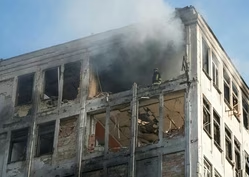
NICK SCHIFRIN: Including overnight, when Russian missile and drone attacks killed at least four and injured dozens, including children.
The light of day didn't stop the terrifying bombardments on a main highway during rush hour.
And while the owner of this coffee shop has no doubt the damage was caused by a Russian drone, he doesn't place the blame solely on Putin.
ANDRII PAKHALOVYCH, Coffee Shop Owner (through translator): If Trump wanted to, he would have given us at least those weapons long ago so that we could defend ourselves, so that we could protect our power and heating plants.
In a month, we'll have freezing temperatures.
What are people supposed to do?
NICK SCHIFRIN: All Ukraine can do is prepare for more days like today.
For the "PBS News Hour," I'm Nick Schifrin.
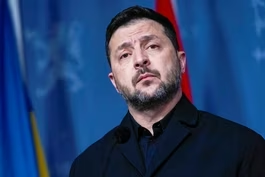
GEOFF BENNETT: For perspective, we turn now to David Kramer, who held a number of senior positions at the State Department during the George W. Bush administration.
He's now executive director of the George W. Bush Institute in Dallas, Texas.
Thank you for joining us.
DAVID KRAMER, Former U.S.
Assistant Secretary of State: Thank you.
GEOFF BENNETT: Let's start with this apparent reset, because, just days ago, as you well know, President Trump, President Zelensky appeared to be at a breaking point.
Today, Zelenskyy says the critical U.S.
intelligence sharing has been restored.
You have European leaders talking about getting diplomacy back on track.
Is this a genuine reset or simply a temporary reprieve?
DAVID KRAMER: It's hard to say.
I certainly hope it is more than temporary, because Ukraine has been suffering as a result of some of the disruptions in provision of intelligence, the Starlink and Starshield that Nick referred to, and Ukrainians have been losing their lives as a result.
The war, let's not forget, was started by Putin initially in 2014, on a full-scale level in 2022.
He is the one who has refused to negotiate and bring about an end to the war that he started.
Ukraine and Zelenskyy have demonstrated repeatedly a willingness and flexibility to end the war and to end the suffering that the Ukrainian people have been enduring.
GEOFF BENNETT: And we have seen this cycle before, a confrontation between Trump and Zelenskyy, followed by efforts to repair that relationship.
What does that recurring pattern suggest about the fundamental challenge in the U.S.-Ukraine relationship right now?
DAVID KRAMER: It's a strained relationship.
We go back in this current administration to the February 28, 2025, infamous White House blowup, where the president and President Zelenskyy were essentially shouting at each other.
And then the relationship got better, on a better track, and the United States imposed some sanctions on Lukoil and Rosneft, the two largest Russian energy companies.
But, more recently, we have seen rhetoric coming out of Washington that suggests that the war is Ukraine's fault.
Ukraine has been the victim of Russian aggression.
That Zelenskyy and Ukraine refused to end the war.
Putin is the one who refuses to end the war.
And so there's been this seesaw that I think has been both exhausting and unnerving for the Ukrainians, but also deadly, because Russia is taking advantage of this and continues its strikes against Ukrainian civilian targets.
GEOFF BENNETT: What do you believe Putin understands about President Trump that allows Putin to really shape President Trump's approach to this war?
DAVID KRAMER: I think, on the Russian side, they have been dangling the prospect of improved U.S.-Russian relations, whether it's for business deals, nuclear negotiations.
Of course, President Putin has offered the possibility of a summit meeting in Beijing next month, when President Trump will travel there for a major international conference.
And the idea of Putin, Xi, the Chinese leader, and President Trump meeting to discuss Ukraine without Ukraine is something the Ukrainians would have great difficulty accepting.
GEOFF BENNETT: What is in Russia's interest?
What is Russia's incentive to end this war?
Putin has suffered enormous battlefield losses.
Russia's economy has come under considerable strain, and yet he continues fighting.
Why?
DAVID KRAMER: Putin doesn't view Ukraine as a truly independent state?
He said this as early as 2008 to President Bush when they met in Sochi.
He wants to put Ukraine under Russia's thumb.
He wants to destroy Ukraine's identity.
He wants to remove the duly elected government in Ukraine, President Zelenskyy, whose term has gone beyond its mandate, but that's because Ukraine had to declare a martial law because of Russia's invasion.
And Putin wants to deny Ukraine the ability to choose its own future, to determine whether it wants to be a member of NATO or the European Union, and it wants to reduce its military.
Putin essentially wants to eviscerate Ukrainian identity, sovereignty, territorial integrity and independence.
And that's obviously something that Ukrainians find wholly unacceptable.
GEOFF BENNETT: Would additional American pressure change Putin's calculations at this point?
DAVID KRAMER: I think it is the way to end this war.
I think it involves tightening sanctions, going after the shadow fleet that Russia depends on to bring in funding for its war effort.
It includes going after Russian banks and more companies and individuals.
It also includes resuming military assistance, whether it's through the system that the Europeans purchase American weapons and then provide those to the Ukrainians or direct military assistance.
We have to remember that the U.S.
Congress passed the Lindsey Graham legislation calling for more sanctions by 86-11 in the Senate and a sizable margin in the House.
Americans, surveys show, support Ukraine.
And so I hope that we will understand that pressure on Putin, not on Ukraine or Zelenskyy, pressure on Putin is the way to try to bring about an end to the war that the president has been talking about since he returned to office.
GEOFF BENNETT: And you, of course, served in a Republican administration that viewed American leadership, support for Democratic allies, resistance to Russian aggression as fundamental national security interests.
How do you explain, how do you understand the transformation of Republican foreign policy under President Trump?
DAVID KRAMER: Well, there has been a major change.
And America first places the priority on different issues.
But I think there should be consistency throughout in recognizing that Ukraine is the country we should be supporting.
Zelenskyy is the one who offered us assistance when Iranian Shahed drones were hitting American targets in the Middle East after the war started there.
The Ukrainians have been the ones who are fighting for their freedom, but they're also fighting for our freedom, given what Russia has been doing to the rest of Europe, even in the United States.
And so supporting Ukraine, I think, serves U.S.
national interests and is something that every Republican and every Democrat, for that matter, should get behind.
GEOFF BENNETT: David Kramer, executive director of the George W. Bush Institute, speaking to us from Dallas, Texas, this evening, thank you for your insights.
Great to speak with you.
DAVID KRAMER: Appreciate it.
Thank you.
AMNA NAWAZ: In the day's other headlines; British authorities say they're sending air support to Saudi Arabia to protect against missiles and drones launched by Iran-backed Houthi rebels in neighboring Yemen.
Defense Secretary Wes Streeting says the Royal Air Force jets will operate in a defensive role and won't hit Houthi targets on the ground.
Separately, U.K.
officials have rearrested two men on suspicion of helping Iranian intelligence in a suspected terror plot on an air base last month.
The U.S.
had used the facility to carry out strikes on Iran, but pulled its bombers out following the threat.
Iran denies any involvement.
Vice President J.D.
Vance says he is not endorsing Israeli Prime Minister Benjamin Netanyahu ahead of next week's elections.
In an interview aboard Air Force Two, the vice president broke with President Trump, who offered his support on Sunday.
J.D.
VANCE, Vice President of the United States: I endorse American candidates, and that's what I'm focused on, is the midterms.
AMNA NAWAZ: The vice president also said he's -- quote -- "not getting involved" in Israeli elections, though he has campaigned for a foreign leader in the past, traveling to Hungary in April to help then-Prime Minister Viktor Orban in his failed reelection bid.
Vance's comments come a day after Netanyahu met with Defense Secretary Pete Hegseth during an unannounced trip to Israel.
In South Sudan, officials are blaming Sudan's military for a drone strike that killed more than 150 people at a market in a disputed area.
Video from the scene shows a giant blaze burning in the Abyei region yesterday.
It's one of the deadliest attacks since fighting erupted in 2023 between the Sudanese Armed Forces and the paramilitary Rapid Support Forces, or RSF.
South Sudan declared independence from Sudan more than a decade ago.
And since then, both have staked a claim to the oil-rich area.
Sudan's military has not confirmed the strike.
In Canada, voters in Alberta overwhelmingly rejected a referendum that would have put the province on a path toward independence.
It's a win for Canadian Prime Minister Mark Carney, who has pushed for national cohesion amid ongoing trade tensions with the U.S.
MARK CARNEY, Canadian Prime Minister: It's a great result for Canada that Albertans have chosen unity.
AMNA NAWAZ: Carney says he spoke with Alberta's premier, who also welcomed the results, about greater cooperation moving forward.
Alberta is a conservative stronghold and home to the world's fourth largest proven oil reserves.
Despite the result, some separatist leaders have vowed to continue their efforts.
The CDC has confirmed a third measles-related death this year, as the U.S.
faces the largest outbreak of the disease in decades.
The health agency cited the fatality on its Web site, but has not said where any of the deaths occurred.
State officials in Pennsylvania had already reported at least five deaths in that state alone.
The CDC has reportedly sent a so-called disease detective to Pennsylvania to address the outbreak.
More than 4,400 measles cases have been confirmed nationwide, as vaccine rates for the highly contagious disease have declined.
Christina Applegate says she was misdiagnosed with multiple sclerosis and has lived for years believing she had the disease.
The Emmy-winning actress told her podcast co-host Jamie-Lynn Sigler from "The Sopranos" that she was -- quote -- "not happy at all" when a doctor recently told her the news.
CHRISTINA APPLEGATE, Actress: This may come as great news, but to me, it comes as like very -- like, I'm back at square one, because you don't get misdiagnosed and then all of a sudden I'm better.
JAMIE-LYNN SIGLER, Actress: Right.
Right.
CHRISTINA APPLEGATE: I haven't gotten better, Jamie.
JAMIE-LYNN SIGLER: Yes.
CHRISTINA APPLEGATE: If anything, I have gotten worse in some ways.
AMNA NAWAZ: Applegate also says she still battles with debilitating health issues, which require the use of wheelchairs.
She first announced her M.S.
diagnosis in 2021.
Since then, she's been an outspoken advocate and wrote about her struggles with the disease in a recent memoir.
Public health experts say nearly one in five patients diagnosed with M.S.
are actually misdiagnosed.
On Wall Street today, stocks ended mostly higher after some strong corporate earnings reports.
The Dow Jones industrial average jumped more than 500 points.
The Nasdaq slipped just six points, so basically flat.
The S&P 500 added roughly a quarter of 1 percent.
And prolific character actor Richard Riehle has died.
RICHARD RIEHLE, Actor: I have people skills.
I am good at dealing with people.
Can't you understand it?
What the hell is wrong with you people?
AMNA NAWAZ: He's perhaps best known for playing an anxious product manager in the 1999 cult classic "Office Space."
With his trademark mustache and Average Joe charm, Riehle logged more than 400 film and TV credits during nearly five decades in the business.
Those included movies such as "Glory" and "The Fugitive" and TV shows like "The Middle" and "The West Wing," among others.
Riehle's management company announced his death yesterday, saying he was a -- quote -- "exceptional talent and a truly wonderful man."
Richard Riehle was 78 years old.
Still to come on the "News Hour": historically Black colleges and universities enter a new fight for equal funding; Ukrainian refugees in Poland find their warm welcome might be coming to an end; and one of the music industry's most in-demand songwriters releases an album all her own.
GEOFF BENNETT: President Trump is back on the campaign trail in the midst of a seven-day blitz that takes him to Greenville, North Carolina, this evening.
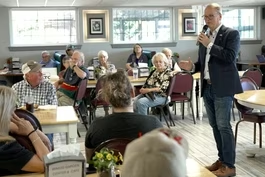
On Monday, the president rallied Republicans in Kansas, a state that has long been reliably red, but where this year's midterm elections are proving surprisingly competitive.
Our William Brangham has more.
WILLIAM BRANGHAM: Last night in Wichita, the president sought to rally Republicans in Kansas to get out and vote.
But his comments were often laced with ugly stereotypes.
At one point, the present used an antisemitic slur while defending Republican Senator Roger Marshall.
Marshall used to be an OB-GYN and has come under fire for suing dozens of his former patients over unpaid medical debts.
DONALD TRUMP, President of the United States: He was given a bum rap because he was mandated by law to request strongly money owed from patients.
You're not allowed not to do it.
You have to, by law, go after those people.
And they made it like, oh, he was some kind of a shylock-type guy.
WILLIAM BRANGHAM: The president also made misleading claims about immigrants in Kansas and about Marshall's Democratic challenger, Pastor Adam Hamilton.
DONALD TRUMP: He supports flooding Kansas with unvetted refugees who go around killing people literally for no reason.
(BOOING) DONALD TRUMP: He used a lot of church money to fund all of this transgender crap that you're reading about, who openly mocks Jesus.
He doesn't have our views, he doesn't have our values, and he happens to be, other than being a pastor -- he's a pastor, I guess, but he doesn't act like a pastor.
WILLIAM BRANGHAM: So for more on this Senate race, we are joined by Jared Cerullo.
He's a journalist with PBS Kansas and the host of the weekly current affairs show "Kansas Week."
Jared, thank you so much for being here.
Help us understand something.
Why is this race so tight?
I mean, Kansas is as reliably red state as they get.
I don't think it's elected a Democrat to the Senate in something like 100 years.
And yet here we have the president feeling the need to come and stump to support Senator Marshall.
How did it get so tight?
JARED CERULLO, PBS Kansas: Yes, you said it.
A Democrat has not -- in many of our lifetimes has not been elected to this seat.
So it seems obviously that Republicans are definitely feeling like they're in trouble.
This race is so close because Adam Hamilton has been a viable candidate.
Many times, we have seen in this state candidates who, quite frankly, aren't viable because Kansas has always been a Republican lock, and they know they're not going to win.
Things really started to go downhill for Roger Marshall last year out in Western Kansas in a small town called Oakley.
He held a town hall meeting and ended up walking out on that town hall meeting.
There were several hundred people there, some of them protesters, and they started asking him challenging questions.
And, by and large, they weren't demonstrating, they weren't protesting, but they were asking him challenging questions.
And Roger Marshall got visibly upset and ended up walking out on the town hall meeting.
And this was early last year.
Democrats obviously began hitting him very hard after that.
The second thing Roger Marshall has been coming under attack for is the billing issue.
He -- as you mentioned, he used to be an OB-GYN in Great Bend, Kansas.
And 81 people were sued by Roger Marshall for not paying their medical debts.
And they weren't -- some of them even went to jail.
And we're talking about low-income mothers, single mothers that went to jail because they ignored court orders.
So that's ultimately why they went to jail.
And the last thing is, Roger Marshall has largely come under attack because Democrats have largely claimed and his opponents have largely claimed that he doesn't even live in Kansas.
There have been widespread speculation that he lives in Florida.
He had a vacation home in Florida.
He did finally start addressing that he does claim to live in Stafford, Kansas.
He does have a mailing address there and claims that he has always lived in Kansas, but that's been widely disputed by his opponents.
WILLIAM BRANGHAM: Kansas, as you well know, is a huge agricultural state, and the Iran war has driven up fertilizer prices, diesel prices.
How much has that played into this race?
I mean, that's got to be causing a lot of real pain for people there.
JARED CERULLO: Oh, absolutely.
Western Kansas especially is very largely agricultural, small towns, many small town -- Dodge City and Garden City are out in Western Kansas, and they're about 20,000, 30,000, maybe 50,000 size population, and that's about as big as it gets.
Everything else is very rural in far Western and North Central Kansas.
And many farmers -- and we see this in Adam Hamilton's ads -- many farmers are complaining that they are having a really hard time, harder times than what they are already facing, largely because of the fuel prices that have just skyrocketed.
And it was interesting at the rally, at the President Trump rally yesterday, just north of Wichita.
Roger Marshall took the podium before and after Trump spoke, and he said multiple times that we're going to lower grocery prices, we're going to lower fuel prices.
But he didn't give any direct plans on how he would do that.
But he said, if you elect me, we're going to lower these prices.
The opponents may say, well, all of these prices have skyrocketed with Republicans in control.
That's what they would say, I think.
WILLIAM BRANGHAM: It's going to be an incredibly interesting race to watch.
Jared Cerullo of PBS Kansas, thank you so much for being here.
JARED CERULLO: You're welcome.
AMNA NAWAZ: In the final sprint to Election Day, more than 12 million votes have already been cast nationwide.
That includes more than 60-5,000 in Philadelphia, a city in the center of a usual presidential battleground state.
The city's vote processes have drawn the ire of President Trump for more than a decade.
In partnership with the Pulitzer Center, Lisa Desjardins takes a closer look at how officials in Philadelphia prepare for voting.
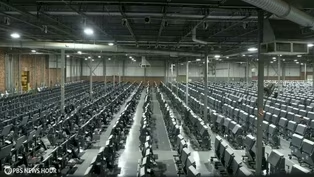
LISA DESJARDINS: Inside this warehouse in Northeast Philadelphia, workers are firing up the machines and paper that run the democratic process.
LISA DEELEY (D), Philadelphia City Commissioner: These are what we call election activity boxes.
So this box will have in it election materials for every division in the city.
LISA DESJARDINS: They hold poll books, rule books, posters, and pens, everything the city's 1,700 precincts need.
Omar Sabir chairs the city's commissioner's board and says the preparations are working.
Mr.
Chairman, how ready do you feel for this election this year?
OMAR SABIR, Chair, Philadelphia City Commissioners: Born ready.
LISA DESJARDINS: Philadelphia's three elected commissioners, two Democrats and a Republican, run elections in Pennsylvania's largest city.
Democrat Lisa Deeley and Republican Seth Bluestein say party allegiance does not factor into the job.
LISA DEELEY: I would characterize the work that we do more as nonpartisan than bipartisan.
Quite honestly, our job is to be umpires, to call balls and strikes.
SETH BLUESTEIN (R), Philadelphia City Commissioner: Running elections in Philadelphia doesn't require democratic values or Republican values.
It requires American values.
DONALD TRUMP, President of the United States: Bad things happen in Philadelphia, bad things.
LISA DESJARDINS: President Trump has singled out the city in every campaign since he was candidate Trump in 2016.
Two days after the 2020 election, as the counting of Philadelphia's mail ballots cut into his lead in Pennsylvania, he lashed out.
DONALD TRUMP: Detroit and Philadelphia, known as two of the most corrupt political places anywhere in our country.
SETH BLUESTEIN: Both Commissioner Deeley and myself were here in 2020, and we saw the danger of the type of rhetoric and what it could possibly lead through.
We have both received death threats and harassment.
LISA DEELEY: I'd never imagined that I would be at the Convention Center during a global pandemic with protesters on both sides.
I had to leave my home and go live in a hotel.
LISA DESJARDINS: Then again, on Election Day 2024, Trump posted there was -- quote -- "massive cheating' in the city, though city officials said there was no substantive fraud complaints.
DONALD TRUMP: Take a look at Pennsylvania.
Take a look at Philadelphia.
LISA DESJARDINS: Since returning to the White House, Trump has said the federal government should step in.
DONALD TRUMP: The federal government should get involved.
LISA DESJARDINS: He's repeatedly claimed without evidence that mail-in voting is rife with fraud, and he's pushed for federal legislation to overhaul elections.
This month, he posted on social media that results in Philadelphia "will often take weeks to rig."
SETH BLUESTEIN: We have the receipts to show that there's not massive cheating in Philadelphia elections, quite literally.
LISA DESJARDINS: How safe is mail-in voting?
What is the chance of fraud?
LISA DEELEY: Mail voting is safe and it's trusted.
This whole vote-by-mail rhetoric, again, dangerous.
LISA DESJARDINS: While there have been a handful of prosecuted cases of fraud in Philadelphia, the largest centered on some four dozen votes.
And there's been no widespread documented fraud in a presidential general election.
But convincing Republicans of that when the leader of their party says otherwise is a challenge for Bluestein.
SETH BLUESTEIN: I have a lot of interactions with local Philadelphia Republicans.
And part of my job is to help them have confidence in how our elections -- how our elections are run.
LISA DESJARDINS: And how hard is that right now?
SETH BLUESTEIN: Well, it's about building trust, right?
So it's about them having confidence in the work that we're doing so that they can say, you know what, I hear what the president is saying, but I know Seth.
LISA DESJARDINS: Counting the vote does take time.
Bluestein says the reason is written into state law.
SETH BLUESTEIN: In Pennsylvania, we can't start the pre-canvass until election morning, when the polls open at 7:00 a.m.
LISA DESJARDINS: Meaning you can't open the ballots.
SETH BLUESTEIN: We can't even review the outer envelopes.
We can't open the envelopes.
We can't get the ballots ready to be counted.
LISA DESJARDINS: By law.
SETH BLUESTEIN: By law.
LISA DESJARDINS: Every mail ballot comes sealed inside two envelopes.
in 2020, opening and processing the city's roughly 375,000 mail ballots meant more than a million pieces of paper.
The count ran until the Saturday after Election Day.
LISA DEELEY: We will never sacrifice accuracy for speed, and we never have.
And since 2020, we have only gotten better.
LISA DESJARDINS: This year's ballots are already being mailed back.
They will wait in a locked cage until Election Day morning, when processing starts.
Officials hope to be done counting by midday Wednesday.
But a specific 2026 worry is new growing pressure from Washington.
DONALD TRUMP: Cheating on mail-in voting is legendary.
It's horrible what's gone on.
LISA DESJARDINS: An executive order signed by Trump in March would have restricted whom the Postal Service could deliver mail ballots to.
The Supreme Court blocked it from taking effect for the midterms.
Trump's same order directs the attorney general to investigate and potentially prosecute state and local officials who issue ballots to ineligible people.
SETH BLUESTEIN: I'm not concerned.
I haven't given it one second of thought.
I don't think it's a realistic threat.
LISA DEELEY: I can't worry about what he says he's going to do to me.
LISA DESJARDINS: Is it fair to say, when you started, this was kind of a boring job?
LISA DEELEY: It was like a wedding planner.
I mean, basically, you had an election, you rolled out the voting machines, people came, they voted, shut them down.
You went back, took everything apart, and six months later, you rolled it back out again.
And now I have to worry about if somebody -- like, might the president of the United States press and -- like, having me brought up on charges for doing my job?
Like, I can't.
LISA DESJARDINS: The president and his administration have also sent mixed messages about whether federal agents will be dispatched to polling places on Election Day.
SETH BLUESTEIN: Pennsylvania law does not allow for officers or federal agents to be within 100 feet of polling places.
So, right there, that is something that I don't foresee happening in any real way in Philadelphia.
LISA DESJARDINS: Is there a plan if something like that happens?
SETH BLUESTEIN: There is a plan that we have worked with our city's law department on to be responsive if there are any problems on Election Day.
And that's not just limited to federal involvement.
It's incumbent upon elections officials like ourselves to think through every possible scenario that can occur and be prepared for them, even if they're not likely.
LISA DESJARDINS: President Trump's attacks on you and other cities' elections infrastructure, do you see it as more of a distraction or do you see it as dangerous?
LISA DEELEY: It's both a distraction and dangerous.
It's both of those things.
It's dangerous, inasmuch as people are losing confidence in our very foundation of voting.
And that is something that I worry is going to take decades to heal.
LISA DESJARDINS: Their advice for people who doubt the process?
LISA DEELEY: If you don't trust the system or you have questions about it, get involved.
Become a poll worker.
Go see firsthand how elections work in Philadelphia.
We always need poll workers.
Sign up.
MAN: They are entitled to the results of the election.
LISA DESJARDINS: That's exactly what 7,200 people have already done, a little short of the 8,000 the city hopes to have in place.
The poll workers attend training sessions, all in preparation for a long and grueling Election Day that begins at 6:00 a.m.
and sometimes runs past 9:00 p.m.
SHANNA FIELDS, Office of the Philadelphia City Commissioners: We really need willing participants who really will care about democracy and care about the work that we do.
LISA DESJARDINS: Shanna Fields oversees poll worker training for the city.
SHANNA FIELDS: Some of them even have my personal cell number, because I want to make sure that they're safe.
We're like 911 for them.
LISA DESJARDINS: Back at the warehouse, hundreds of voting machines are lined up, ready to be sent out to polling locations across the city.
When the polls close, the results come back here to be combined and tallied.
Since voting machines have no Internet connection, the counts are transferred by secure compact discs to another computer to be released to the public.
SETH BLUESTEIN: I want every voter to have the confidence in our election system that I have.
And that's what we're going to continue to do, is to help them have that confidence.
LISA DESJARDINS: After it's over, the count is audited and their work will begin almost immediately to prepare for the next election.
For the "PBS News Hour," I'm Lisa Desjardins in Philadelphia.
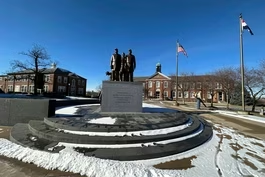
GEOFF BENNETT: A new lawsuit in Missouri could have sweeping implications for the nation's historically Black colleges and universities and the billions of dollars they say they have been denied over decades.
Current and former students at Lincoln University are suing the state for nearly $549 million, alleging that Missouri systematically underfunded the school compared with the University of Missouri.
The case could become a model for similar legal challenges across the country.
Joining us now is Don Calloway, a former Missouri state lawmaker and attorney who founded The 1890 Project to challenge longstanding funding disparities at historically Black land grant universities.
He's also leading this lawsuit against Missouri.
This conversation, we should say, is part of our series on higher education called Rethinking College.
Don, it's great to see you.
DON CALLOWAY, Founder, The 1890 Project: Good to see you, Geoff.
GEOFF BENNETT: So we know for decades HBCUs have been receiving less funding than their predominantly white counterparts.
But you're arguing that what happened at Lincoln University in Missouri, you're saying that this wasn't simply unfair, that it was illegal.
What exactly did the state do wrong and what makes this a violation of federal law?
DON CALLOWAY: So, from 1987 to 2020 -- really to the present, but through 2020 on paper, we see for the first time, because the federal government started tracking -- based upon the states' -- individual states' own reporting, the federal government started tracking and then publishing exactly what each state allocated to its land grant institutions.
So it's an important context here.
Every state in the country has a flagship university, your University of Missouris, your Auburn Universities.
That is an 1862 land grant institution, which the government gave thousands of acres to place a school and give -- then gives millions of dollars a year to each school to fund.
After slavery ended, in 1890, there came a series of those land grant institutions for the freed slaves to educate them concurrently.
And what we have found is that, from the inception, every state has not met its obligation to fund the 1890 equitably with the 1862.
As a result, we didn't see that data published until 2023.
It goes back to starting in 1987, which was the first year that the feds began to aggregate that data.
And so our lawsuit is based upon the notion that the state of Missouri underfunded Lincoln University as compared to the University of Missouri, to the tune of about $361 million, since we have begun tracking the data.
GEOFF BENNETT: So we're talking about hundreds of millions of dollars.
Those numbers can feel abstract, but what has the loss of funding actually meant for generations of students at Lincoln University?
DON CALLOWAY: Yes.
Well, a couple of things.
I'm glad you asked that.
First of all, it's not just Lincoln, but there is an aggregate across the 1890s of about $12.6 billion of the 16 states who did not properly fund their 1890, as compared to their 1862.
But there are real, tangible damages here.
You take career earnings of a FAMU graduate compared to a Florida State graduate, a Fort Valley graduate in Georgia, as compared to the University of Georgia graduate.
When you attend an institution that has been hampered by demonstrable underfunding, the facilities are in disrepair.
That has a definite effect on the quality of life on campus.
The programmings, access to advisory facilities, access to all of the things that one believes goes into the standard of life that one expects from a reasonably competitive college are diminished.
And we see the results of that as you enter the professional sector, whether it's private or public, through end of life.
GEOFF BENNETT: You used to serve in state government.
DON CALLOWAY: Yes.
GEOFF BENNETT: So you know that states can say, look, we make funding decisions based on enrollment, institutional needs, performance, budgetary issues.
Where is the legal line between a legitimate funding decision and unconstitutional discrimination?
And how can you prove that Missouri crossed that line?
DON CALLOWAY: Yes, that's a great question.
Well, one of the ways that Missouri underfunded Lincoln is, it created a five-metric rubric.
And so it has -- gets a certain amount of money from the federal government.
The state of Missouri is supposed to match that.
Well, what it did in Lincoln's case is created a five-metric rubric that apportioned 20 percent of its state match, which was mandatory, upon Lincoln hitting these certain metrics.
They didn't apply that metric to the University of Missouri.
So that is facially unconstitutional, inasmuch as, number one, the state had no precedent to create this thing.
But, secondly, they didn't apply it equally to the University of Missouri to determine its match.
So that, in and of itself, whether or not we ever achieve the remedial fund of the corpus of $361 million, that funding metric can be destroyed immediately.
And that provides us the prospective relief.
But that's just one of the ways that we make a very clear legal argument that this was fundamentally and facially unconstitutional.
GEOFF BENNETT: The $549 million number, how did you arrive at that?
DON CALLOWAY: That's a figure with nominal interest.
The 548 is salacious.
It makes it a bigger headline, but that's with nominal interest calculated.
I hope that we don't have to get that because we'd be glad to settle for the objectively indisputable 361 that was withheld from Lincoln.
GEOFF BENNETT: As you were putting this case together, did you happen upon the reason why, why whoever it was put these hurdles in place for Lincoln to get the money that they were owed... DON CALLOWAY: Yes.
GEOFF BENNETT: ... and those same hurdles were not in place for the University of Missouri?
DON CALLOWAY: Well, I don't think it's any different in Missouri than it is in Arkansas, Pine Bluff, as related to U.A., or Florida, again, FAMU as related to Florida State.
It's just a vestige of a segregated higher education system.
And so I'm not looking at any individual legislator or governor or attorney general across the country.
You can't look at anybody and say, hey, you're wrong, you're racist.
Most of us, and I'm talking to me because I was a legislator at the time, most of us just inherited the system we were given.
But when the data was published and made plain on September 18, 2023, you have an obligation to do better once you know better, right?
And so that is the very objective case we're bringing, and we're asking legislators of good faith to make a very clear decision to right a historical wrong, but, more importantly, fix the funding metrics going forward so that these institutions are strengthened for the future.
They're not -- Lincoln is not a majority-Black institution anymore.
GEOFF BENNETT: True.
DON CALLOWAY: It is -- the current student body is more white.
You could say the same thing for West Virginia State, also a historically Black institution.
And so what you're doing is harming an entire region of people who have played by the rules, gone to college, stayed out of trouble, and they're going into a work force with diminished economic prospects.
And I think every legislator, regardless of party or political affiliation, has an interest in fixing that.
GEOFF BENNETT: If you prevail in Missouri, this could potentially open the door to billions of dollars of claims nationwide.
DON CALLOWAY: Yes, we will absolutely prevail in Missouri, first of all.
But, once we do so, it does open the door and it already has, because your historically Black land grant colleges have the same case across the board.
Every state's underfunding might have been done in a little bit different ways and different nuanced ways, but the objective violations of the 14th Amendment Equal Protection Clause are there across every state.
So, we have already heard from legislators in Oklahoma, Virginia, Texas, all of whom are interested in helping us bring their case.
So we're very excited about the potential national ramifications, which could fix this historical wrong going forward.
GEOFF BENNETT: Attorney Don Calloway, good to speak with you.
DON CALLOWAY: Geoff Bennett, pleasure, man.
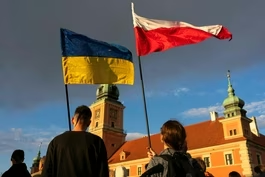
AMNA NAWAZ: Poland has been one of Ukraine's staunchest supporters since the full-scale Russian invasion.
But many of its people are slowly turning against the one million Ukrainian refugees given sanctuary over the last four-plus years.
Divisions between Poles and Ukrainians are being exacerbated by bitter cultural memory of a World War II massacre, as special correspondent Malcolm Brabant reports from the Polish capital of Warsaw.
MALCOLM BRABANT: Warsaw's Central Station in March 2022 two weeks after the Russian invasion of Ukraine, the concourse was packed with refugees fleeing the war; 4.5 years on, nearly a million Ukrainian refugees remain here.
Only Germany provides sanctuary for more.
After enduring the war for a month, Natalia Klimenko escaped to Poland with eternal gratitude.
NATALIA KLIMENKO, Ukrainian Refugee (through translator): When I came, do you understand, I still can't talk about it without crying.
They welcomed us as if we were family.
I was stunned by this welcome, like relatives on the border.
MALCOLM BRABANT: What a difference four years makes.
In 2022, when Russia invaded Ukraine, 94 percent of all Poles were in favor of welcoming Ukrainians fleeing the front lines.
But now, according to the latest public opinion survey, more than half the nation, 52 percent, to be precise, oppose the idea of giving sanctuary to those running away from the war.
Occasionally, Polish antipathy towards Ukrainians escalates to violence.
This couple was attacked after their assailants heard them speaking in their native tongue.
Dmytro Dymydyuk mans a hotline at a Ukrainian help center.
So palpable is the hostility in Warsaw that he maintains a very low profile.
DMYTRO DYMYDYUK, Coordinator, Ukrainian House Foundation: I try not to use social media.
I don't write any comments.
I don't take part in this holy wars in social media.
So I just try to live normal life, job, house, shops, et cetera.
So I try to avoid any places, any manifestations where someone from Polish side can attack me.
NATALIA PANCHENKO, President, Stand With Ukraine: Last few months, we have every month more and more calls, when people are calling us, and they need support because they are victims of hate crimes.
MALCOLM BRABANT: Natalia Panchenko, president of a nonprofit called Stand With Ukraine, blames extremist politicians.
NATALIA PANCHENKO: The role of politicians is very important on everything which I'm talking to you about, because hate speech or hate crime is a result.
First, politicians start to show Ukrainian community in Poland as someone very bad.
GRZEGORZ BRAUN, Leader, Confederation of the Polish Crown: Polish crown This is Poland.
This is not some Ukropole.
MALCOLM BRABANT: Grzegorz Braun is an ultra-right politician who is not easily ignored.
In the 2025 presidential election, he surprised his critics by winning 1.2 million votes.
GRZEGORZ BRAUN: With people coming from other countries, we get social diseases, and not only social diseases.
As a bonus, we get costs.
MALCOLM BRABANT: Braun shocked Poland during a sacred Jewish holiday when he extinguished a menorah in the Polish Parliament.
Braun is brazen about his antisemitic beliefs and hatred for what he calls the Ukrainization of Poland.
But isn't it the decent thing to do as a neighbor to offer sanctuary to your neighbors when they're under threat from one of the most powerful militaries in the world?
GRZEGORZ BRAUN: OK.
OK, is it a decent thing to do having a neighbor in trouble with problems making a hole in Europe, house's wall, and inviting your neighbor with his problems, probably giving him your wallet and all the keys to your apartment, your car?
It's not a decent thing.
MALCOLM BRABANT: Such rhetoric has contributed to a Ukrainian exodus.
In the past six months, over 100,000 have left Poland.
NATALIA PANCHENKO: Unfortunately, yes, it's true.
Some people can't feel here safe, and they are leaving our country and going to different countries.
Some of them even come back to Ukraine, Ukraine, which is still under attacks every day.
MALCOLM BRABANT: Behind the scenes, Moscow is suspected of stirring the pot of resentment.
FILIP BRYJKA, Polish Institute of Foreign Affairs: Obviously, Russia is the main beneficiary of this -- tensions between Poland and Ukraine.
MALCOLM BRABANT: Defense analyst Filip Bryjka specializes in Russian hybrid warfare.
FILIP BRYJKA: Since 2014, actually, Russia is holding long-term disinformation campaigns targeting Polish Ukrainian bilateral relations.
Mostly, those campaigns are related to the some historical disputes.
MALCOLM BRABANT: In Warsaw, activists are reminding people of the slaughter of 100,000 Poles in the region of Volhynia 83 years ago.
The pogroms, labeled genocide by the Poles, were carried out by Ukrainian ultranationalists.
They were led by Stepan Bandera, who, during the Second World War, collaborated with the Nazis in the fight against Stalin's Soviet Union.
JAN DARASZ, Historian: The Ukrainian paramilitary surrounded defenseless villages, dragged out the men, women and children, massacred them using farm implements, axes, scythes, hammers, that sort of thing.
The houses were looted and burnt.
MALCOLM BRABANT: Jan Darasz is a historian and journalist with Polish television.
JAN DARASZ: History matters in Poland.
It's very comparable to what we saw in Rwanda.
MALCOLM BRABANT: Ukraine's President Volodymyr Zelenskyy has aggravated Polish sensitivities by naming a contemporary military unit after the Second World War Ukrainian insurgent army, Stepan Bandera's militia.
Zelenskyy was stripped of Poland's highest state honor as a result.
Poland's president, Karol Nawrocki, branded Zelenskyy's decision an outrageous glorification of historical atrocities.
It may have been Zelenskyy's intention to honor the insurgent army's fight against the Soviet Union, but Poles don't see it that way.
Activist Pawel Kryszczak: PAWEL KRYSZCZAK, Anti-Bandera Activist (through translator): Since the wave of refugees from Ukraine arrived, we have seen an increase in the spread of vandalism, flags, or other symbols that simply clearly indicate a reference to the ideology that led to the death of hundreds of thousands of Poles in Volhynia.
MALCOLM BRABANT: In the past year, funerals have been held for about 100 massacre victims whose bodies were exhumed from mass graves.
But there are tens of thousands more victims who aren't awaiting a Christian burial, and whose murders aggravate the division between Ukrainians and Poles.
President Zelenskyy has shown no signs of reversing his decree and has doubled down, saying it's a matter of internal sovereignty.
JAN DARASZ: There's two views of the same problem, and I don't think it's capable of being resolved.
MALCOLM BRABANT: With sympathy and charity dwindling, Ukrainian refugees are hoping that the issues driving a wedge between the two countries don't become even more inflamed.
For the "PBS News Hour," I'm Malcolm Brabant in Warsaw.
GEOFF BENNETT: You may not know the name Sasha Alex Sloan, but chances are you have heard her work.
She's become one of music's most sought-after songwriters, writing across pop, country, K-pop, and R&B for artists, including Olivia Rodrigo, Bruno Mars and Karol G, and Charlie Puth.
Now, as Sloan is in contention for a Grammy nomination for songwriter of the year and prepares to release an album of her own, she joins us to talk about the craft of songwriting and to perform one of her own songs here in our studio.
Sasha Alex Sloan, welcome to the "News Hour."
SASHA ALEX SLOAN, Musician: Thank you.
Thanks for having me.
GEOFF BENNETT: So tell me what it's like to be a songwriter.
When you walk into a room with an artist, how do you craft something without imposing your own voice on it?
SASHA ALEX SLOAN: It's a great question.
And every room is so different, so there are a million different answers to that question, but I think it just depends on who you're writing with.
And I think, when you're the songwriter in the room and not the artist, it's all about them.
It's their voice, their ideas.
And so I think your job as a songwriter is to just help them be heard.
GEOFF BENNETT: As we said, you have written pop songs, R&B songs, country, rock.
What makes a song work regardless of genre?
SASHA ALEX SLOAN: So I always say a song is like a script, and the production is the set.
And I think any song -- I'm going to maybe take that back later, but, for the most part, any song can be made into any genre with the right production.
And so I think, as the story -- as long as the story's good, the rest is -- you can figure out.
GEOFF BENNETT: I wonder, do you have a story about somebody you have worked with who we would know that really stands out?
SASHA ALEX SLOAN: I got the privilege of working with Olivia Rodrigo and Dan Nigro, and it was just an incredible time.
I just felt so honored to be there and grateful to be in the presence of that level of greatness.
And I eventually heard a couple months later that Robert Smith was featuring on the song, and then I basically realized that I peaked and I should probably quit.
(LAUGHTER) GEOFF BENNETT: Hardly.
So the song you're going to perform now, "Empty," what should we know about it?
What does it say about you as a songwriter or artist?
SASHA ALEX SLOAN: "Empty" is one of my favorite songs I have written recently.
It's just about being codependent.
I read this book called "Codependent No More," and I am the biggest people pleaser on earth, and I give and give, and I try to fix people, and I think that's love.
And it's not.
And this song is kind of my realization of that.
GEOFF BENNETT: This is Sasha Alex Sloan performing "Empty" off the new album "And The Crowd Goes Mild."
It's a great title, by the way.
SASHA ALEX SLOAN: Thank you.
GEOFF BENNETT: And that's the "News Hour" for tonight.
I'm Geoff Bennett.
AMNA NAWAZ: And I'm Amna Nawaz.
On behalf of the entire "News Hour" team, thank you for joining us.
 New
HBCUs enter new fight for equal funding
Video has Closed Captions
HBCUs enter new fight for equal funding (7m 35s)
 New
How the Kansas Senate race became surprisingly competitive
Video has Closed Captions
How the Kansas Senate race became surprisingly competitive (5m 53s)
 New
Inside Philadelphia's preparations for Election Day
Video has Closed Captions
Inside Philadelphia's preparations for Election Day (8m 43s)
 New
New sanctions on Russia is how to end war, says David Kramer
Video has Closed Captions
Tightening sanctions on Russia is 'the way to end this war,' says David Kramer (6m 26s)
 New
News Wrap: Britain sending air support to Saudi Arabia
Video has Closed Captions
News Wrap: Britain sending air support to Saudi Arabia amid Houthi attacks (5m 31s)
 New
Sasha Alex Sloan performs 'Empty'
Video has Closed Captions
Sasha Alex Sloan performs 'Empty' and discusses the craft of songwriting (5m 27s)
 New
Ukrainian refugees face growing hostility in Poland
Video has Closed Captions
Ukrainian refugees face growing hostility in Poland (8m 14s)
 New
Zelenskyy moves to repair ties before Witkoff-Putin meeting
Video has Closed Captions
Zelenskyy seeks to mend ties with Trump ahead of Witkoff-Putin meeting (3m 52s)
Providing Support for PBS.org
Learn Moreabout PBS online sponsorship New Episode
- News and Public Affairs

Today's top journalists discuss Washington's current political events and public affairs.
 New Episode
- News and Public Affairs

FRONTLINE is investigative journalism that questions, explains and changes our world.
 New Episode
 New Episode
 New Episode
 New Episode



 New Episode
 New Episode


 New Episode
Support for PBS provided by:
Major corporate funding for the PBS News Hour is provided by BDO, BNSF, Consumer Cellular, American Cruise Lines, and Raymond James. Funding for the PBS NewsHour Weekend is provided by...