
Handle with Care
9/24/2026 | 26m 46sVideo has Closed Captions
A deadly bat disease, protecting bees and the benefits of waterfalls. Plus, saving oysters.
The impact of white-nose syndrome on North Carolina bats, a beekeeper’s fight to protect pollinators and how waterfalls affect a park’s ecosystem. Plus, UNC Research looks at how to save oysters from mass die-offs.
Problems playing video? | Closed Captioning Feedback
Problems playing video? | Closed Captioning Feedback
SCI NC is a local public television program presented by PBS NC
Sci NC is supported by a generous bequest gift from Dan Carrigan and the Gaia Earth-Balance Endowment through the Gaston Community Foundation.
Handle with Care
9/24/2026 | 26m 46sVideo has Closed Captions
The impact of white-nose syndrome on North Carolina bats, a beekeeper’s fight to protect pollinators and how waterfalls affect a park’s ecosystem. Plus, UNC Research looks at how to save oysters from mass die-offs.
Problems playing video? | Closed Captioning Feedback
Where to Watch SCI NC
SCI NC is available to stream on pbs.org and the PBS app.
Related to This Episode
Providing Support for PBS.org
Learn Moreabout PBS online sponsorship- Coming up on Sci NC, protecting bat populations, hidden threats to honeybees, saving oysters, and more next.
- Quality public television is made possible through the financial contributions of viewers like you, who invite you to join them in supporting PBS NC.
- Sci NC is supported by a generous bequest gift from Dan Carrigan and the Gaia Earth Balance Endowment through the Gaston Community Foundation.
(gentle music) ♪ - Hi again, and welcome to Sci NC.
I'm Laura Smith.
Bat populations across the country are dropping fast in parts of Western North Carolina by as much as 90%.
So what's causing it?
Producer Michelle Lotker joined a team studying these bats up close, hanging out with them from dusk till dawn.
- There we go.
We saw our first bat flying a little bit earlier than we were gonna open nets.
So we kind of scrambled to get over here and open these nets real quick so that maybe we can take advantage of anybody who's out here flying.
- [Michelle] We're in Nantahala National Forest trying to catch bats.
- Oh!
- Yeah.
- [Michelle] This species hasn't been caught in this part of Western North Carolina in over a decade.
- Hi, little cutie.
- [Michelle] A fungus has been causing something called white nose syndrome in hibernating bats and decimating populations across North America.
- For North Carolina, our biggest threat to bats is white nose syndrome.
It's caused by a fungal pathogen that affects bats when they're hibernating.
Not all 17 bats in North Carolina hibernate, so it doesn't affect all species, which is the good news.
But the species that it affects the most, we have seen really significant population declines in, and those are really four species, the Indiana bat, little brown bat, tri-colored bat, and Northern long-eared bat.
We've seen over 90% population declines for those species here in Western North Carolina.
They've become so rare that they're really hard to even find.
So that's our job, really, is to figure out where these white nose syndrome survivors are so we can help provide what they need so they can continue to survive.
All right, we're gonna start.
Hey, everybody, welcome to the Bat Blitz.
Thanks for being here.
We have a lot of questions about what bats are out here, so we really needed a huge survey effort to figure that out.
- [Michelle] This area used to be one of the best places in North Carolina to catch the four bat species most impacted by white nose.
But for a decade, researchers haven't been encountering those bats.
- Last year, very incidentally, we caught some little brown bats in the area, and that's what spurred us to host a blitz.
Find your team leaders and get ready to go.
Thanks again for being here, and good luck.
- [Michelle] More than 60 people have come together for this intensive bat survey.
For three nights, they'll go out from before sunset until 1 a.m.
and monitor nets across likely bat flyways.
Bats get a bad rap through negative stereotypes, but they play an important role in ecosystems, especially keeping insect populations in check.
- Bats in North Carolina all eat insects, and they eat a lot of insects.
A single female bat in the summertime can eat up to her body weight in insects, which is a lot if you really stop and think about eating your body weight in something.
So while we're sleeping all night, every night, these bats are out here being kind of an unsung hero in eating insects, controlling insect populations.
So even if you don't really love bats, I think we can all find a way to respect bats and their place in the ecosystem.
We've got 21 total sites that should get surveyed during the course of this blitz.
- [Michelle] One of the sites surveyed during the blitz had an unusual feature.
- So this cabin is 100 years old, and bats tend to like it and be around it, sometimes in it.
- [Michelle] We spotted some bats snoozing in the shingles on the cabin.
- So what you're looking for is these brown cylinders, which are bat guano, bat droppings.
There's plenty.
So if you look back up in the shingle and shine a little light right there, you see these little noses?
There's one, two, and there's three right here.
- We happened upon this cabin one time through some surveys when we were in the area and realized there was some bat guano in and around the structure, and that led us to find some little brown bats.
We didn't see them in the building, we just caught them in our nets.
So they may come and go and use the building or they just may be in the area.
That's why we're here, that's why we're netting in kind of a unfamiliar or odd place for us, unusual place, I should say.
And hopefully we'll get lucky like we did last time we were here.
- [Michelle] To catch a bat, you have to think like a bat.
- We look for places that we think bats are flying, and especially look for corridors, like stream corridors or trails or roads, places that we can funnel bats into our nets.
So this is called a mist net and it's used for catching bats, it's also used for catching birds.
It's the same type of net, we just use it a little bit differently and at different times of day.
We put them on these pulley ropes as well so that wherever a bat may land in the net, we can pull the net down to our level and get the bat out.
- [Michelle] Night one was rainy, so not ideal for bats to be out and about, but we still got lucky.
- Oh, I see him.
- It's banded?
That's cool.
That's one of ours.
- [Michelle] You might be wondering why everyone looks like they're ready to do surgery.
To prevent the spread of white-nose, researchers scrub in and out each evening, sterilizing the clothes they wear, the nets they use, and decontaminating all tools and using new gloves between bats.
- Oh my goodness, you're so little.
So this is a little brown bat, and this is what started off this whole idea of planning a blitz, is catching one of these guys at this site.
So we're happy to see this little brown tonight, especially with this rain.
It's always great to get a recapture.
It means this individual has survived since the last time we saw it.
And that's really great data for us, and just good to see that these bats are surviving, even with white-nose.
So very, very pleased for this little capture, yeah.
- [Michelle] Despite the rain, we also caught several Eastern small-footed bats, and a big brown bat, one of the bats most commonly found in human structures.
- They're a little bit more feisty.
Serving bats in Western North Carolina is important because we're trying to keep the species that we have here.
So we can't do any of that unless we know where they are.
We know something about what they're relying on, what resources they need, and we can help to make sure they have those resources.
- [Michelle] On night two, hopes were high for better weather.
- We've got six nets up.
That's a big effort for us.
Usually we put up three or four.
So we kind of threw all of our energy and effort at it, and hopefully we'll reap the benefits.
- [Michelle] Efforts paid off in Eastern red bat bounty.
- A red?
Aw, yay!
This is an Eastern red bat.
This is one of our most common species that we have in the state.
They roost in trees, and in the winter, they'll sometimes overwinter under leaf litter on the ground.
- [Michelle] Eastern red bats are a migratory species, so they don't hibernate and aren't affected by white-nose.
We had an unwelcome but adorable visitor.
- Woo!
- No, baby.
No, not towards me.
No, no.
No, baby.
Woo!
There you go.
- They will destroy a net.
That's why we were all like, "Get those flying squirrels out of the net!"
- [Michelle] But the most exciting thing this evening was catching another rare species, a tricolored bat.
- We got tricolored.
Yeah, go us!
That's why we're here.
So this is the other smallest bat in the state.
We've caught an eastern small-footed and a tricolored bat.
Now we have both of the smallest bats in the state.
Let's look at your wing.
- Is that cute?
- I think we are.
Well, let me see.
Yeah, yeah, yeah, yeah, yeah, yeah.
Woo, woo, woo, woo.
- [Michelle] At this point, I have no idea what's going on and why everyone is so excited.
- So anytime we see a juvenile bat, it's a really good sign for a white-nose affected species 'cause they're reproducing in this area.
It's a really helpful thing for their management to know that reproductive individuals are around for these rare species.
We're glad you're here, little juvenile.
Tonight went surprisingly well.
We had 11 bats total.
The big kind of highlight of the night were two tricolored bats.
The most exciting part of that is that they were both juveniles.
That means they were born this summer, and that's what we wanna see.
We wanna see these bats actually surviving a white-nose syndrome infection and reproducing.
And so this was evidence of reproduction in this area, and that's huge.
- [Michelle] Overall, the bat blitz caught 252 bats of eight species.
Another team also caught a little brown bat, which tells us more about where they're living.
The last night of the blitz had clear weather, and almost all sites had abnormally high captures of eastern red bats, 146 in total, plus some other migratory species.
They were likely taking advantage of the lack of rain.
Surveys like this one answer some questions and raise new ones as more data is gathered.
That mystery is what Katherine loves about working with bats.
- I've always been a pretty curious person, and bats make me endlessly curious.
There's so much that we don't know about them, so many things that I find truly fascinating about them, and just trying to answer those questions continually is just an itch I'll never fully scratch.
And so it's just fun to always work towards learning more about them and helping conserve these really special creatures in North Carolina, my home state.
- All right, from bats to bees, Skip Story found his happy place in the hum of a beehive.
But with pollinator numbers falling, that hum is getting harder to find.
Producer Evan Howell takes us inside one beekeeper's fight to protect the tiny workers that help feed us all.
(gentle music) - Keeping of the bees makes you be tranquil, makes you relax.
It's 90 degrees outside, sweat's dripping off of you.
The bees are binging you on the nose, et cetera, but you're still in your happy place.
- [Evan] Skip Story fell in love with bees and found his calling after watching a documentary about the insects.
Story's happy place has been raising bees ever since.
- I could probably do that.
And my wife said, "Oh, I will plant for them to have a garden to feed, and you just work the bees."
We're smoking the bees, so when I start to open the colony up, they are more calm.
- [Evan] However, raising bees isn't easy.
Predators and diseases are a constant threat to the bees, the hive, and to a beekeeper's bottom line.
No bees, no honey to sell.
- An economic threshold for bees sort of varies in the season.
Usually it's 1% to 2%, and once it exceeds that 2% level, then you need to treat.
- [Evan] But before we talk about threats to bees, we're gonna check out how a beehive actually works.
Just talk through a little bit about what you're doing here, Skip.
- Okay, taking the inner cover off, and as you can see, the bees- - Well, there are the bees.
- There are the bees, and they are coming out.
- Holy moly.
- So basically what you can do, or what I would do, is we see that we have all the bees on top of these frames, and as I move my hand across the top, you can see the bees will start to hit my hand.
Those bees that are hitting my hand are guard bees.
Basically what they are telling me is that they are not happy with what I'm doing.
So I'll put a little smoke on here, and basically what that will do is now all the bees have been pushed down in the box.
- [Evan] The reality is that honeybees are being pushed from all sides, and not in a good way.
Pesticides, habitat loss, extreme weather, and importantly, disease.
Some beekeepers are sounding the alarm.
- Hilborn to the set.
- [Evan] That's where a new specialist comes in, the bee veterinarian.
Bee vets like Elizabeth Hilborn wait for that call.
Threats to hives include varroa mites, which are parasites that can also spread disease.
- You know, I have to be able to know and look at these and say, "Oh, they're not acting right.
"I think it's got ABC."
And I have to have some medication to treat these bees, so I have to call Elizabeth, 'cause she's the vet.
- It's a lot of work.
It's not just putting a colony in your yard and walking away.
It's active management.
Varroa mites are the biggest threat to honeybees, and unfortunately, they don't stay with honeybees.
As the bees move around to flowers, those mites can drop off on the flowers.
They can be picked up by bees from other colonies, and those diseases, the viruses that Skip alluded to, can also be spread to native bees.
So varroa mites are something that really need to be managed right now, as the bees can't do it themselves.
- [Evan] There's also European foulbrood, which is a disease that affects bee larvae and can turn a hive into this gooey mess.
- Is this a honey super you have on?
- [Evan] Whatever the diagnosis, if medication is needed, Hilborn gives a beekeeper a prescription, in this case, for European foulbrood, which is sprinkled on top of the hive over a period of a few months.
[buzzing bees] While honeybees get most of the attention, they're just one species of bee.
Hilborn says there are about 550 native bee species which are equally critical to the health of an ecosystem.
Mining bees, mason bees, and bumblebees, for example, all contribute to the pollination that helps produce the food we put on our tables.
- And we don't treat their illnesses.
Native bees are on their own.
So native bees are dependent upon the environment, and our environment is degrading.
We're doing more development, eliminating native bee habitat.
We're losing flowers 'cause people tend to mow more or take out plants with herbicides.
So we have fewer flowers for the bees to feed upon.
- If these pollinators aren't out there, then probably up to one third of our food, we would not have.
- [Evan] Back with his honeybees, Skip Story knows the concerns about the entire bee population.
His search for his happy place has turned him into an educator and an advocate for bee survival.
And he's still hopeful.
He says if we just listen to the bees and give them room to grow and the pollinating resources to thrive, maybe the ecosystem will have a fighting chance.
- A lot of times people find their happy place in strange places.
Is it stressful?
Yes.
Do you get upset?
Yes.
But you're able to get back to that happy place very quickly.
- Is it just me or does the sound of a waterfall make you feel better?
Well, it turns out they're good for more than just relaxation.
See how they help the world around us.
[rushing water] - [Laura] Listen for a second.
That sound is older than almost anything you've ever stood next to.
The rock behind it, roughly 500 million years old.
- And all the different layering you can see in the rocks behind us is evidence of all the years of different layers of rocks that used to be here in the past and have since eroded away.
- [Laura] The water has been carving its way down for so long that the mountain it started on used to be six times taller.
- All of it is evidence of erosion, the water streaming down and creating a little valley that we're in.
- [Laura] This is Upper Cascades in Hanging Rock State Park, one of five waterfalls.
Park ranger, Carson Orton, says it's one of the most fragile classrooms in North Carolina.
- How it forms is there's a top layer of rock and a bottom layer of rock.
And the top layer of rock is a lot more hard and durable for erosion.
And the bottom layer of rock is gonna be softer.
And here at Upper Cascades and in the Sauratown Mountain Range that we're in, we have quartzite.
And quartzite's a very strong and sturdy rock.
So that's why we have cascades and not waterfalls.
So cascades is basically the water's flowing down the cliff and a waterfall is the water's flying off the cliff and just falling, free falling.
- [Laura] Underneath the falling water is what scientists call a plunge pool.
It's a churning, oxygen-rich, low-nutrient bowl and really its own little world.
- It's a very moist ecosystem, obviously, 'cause the water's just constantly flowing.
It's very wet, very even temperature year round.
And again, very fragile.
So you have to be careful around it.
- [Laura] It houses salamanders, crawdads, specialized ferns, and moss that grow nowhere else in the park.
Dragonflies and butterflies rely on the puddles the waterfall leaves behind.
- Everything's connected.
And waterfalls have a huge impact on the environment 'cause they're a very specialized ecosystem.
- [Laura] And it's connected to something bigger.
Orton traces the water from a spring near the top of the mountain all the way to the ocean.
- The spring that starts here will empty into the Atlantic Ocean.
It shows how everything's connected and how the impact we have here will also affect everywhere else in the United States and potentially the world.
- [Laura] That connection goes both ways.
The park is good for nature and the park, it turns out, is good for us too.
- We as humans look at a natural green environment.
We actually get reduced blood pressure for us.
There's also invisible compounds that are coming from plants and animals around us.
We're all getting 'em right now.
And for the plants and animals, it protects 'em from disease and insects.
But for humans, it actually reduces the stress hormones in our body.
And then finally for the waterfall itself, it's obviously a natural body of water.
And there's something called the blue mind theory, which basically is a scientific explanation of why we feel calmer around water, natural bodies of water, such as the waterfall, lakes, oceans, streams.
We feel calmer.
It, again, reduces stress hormones in our body.
It actually increases creativity.
- [Laura] None of this, the trails to the falls, the stone steps to the visitor center, would exist without a group of young men who showed up in the middle of the Great Depression and started building.
- The story of Hanging Rock relatively begins in 1936.
And it started with the Civilian Conservation Corps.
We're talking young men between the ages of 18 to 25 were put to work to build this North Carolina State Park.
- [Laura] 90 years later, it looks like it did when they finished.
- It has relatively gone under little change.
The trees that were here a hundred years ago, roughly the same.
The mountains, millions of years old, still here.
- [Laura] Ranger Jacob Field says, you're not just looking at a view here, you're looking at deep time.
- See, at one point, these mountains could be roughly 14,000 feet in elevation.
Now the highest point is 2,500 feet, give or take.
So over the course of time, this mountain was once tall and now very short, still providing this element of beauty, of landscapes.
- [Laura] Fields calls Hanging Rock, the mountains away from the mountains.
♪ To celebrate the park's 90th, the Rangers didn't throw a party.
They built a science fair at the visitor center.
- What's this?
- That is called a Jacobson's organ.
And what that does is when they flick their tongue out, they're using that to smell.
- And the idea was to have various stations that taught science, technology, and some type of engineering, maybe some math, and how it relates to North Carolina State Parks.
- [Laura] Kids held snakes, counted tree rings, learned how Rangers use science every day on the job.
- Science is important 'cause if you don't know what you have there and you don't study it, you might lose something very valuable.
So if you don't know what kind of trees you have, what kind of flowers are blooming, what kind of fish you have in your streams, any of that, then you might lose out on a very valuable natural resource.
If we don't preserve or conserve what we have here, our future generations won't have the ability to see it or respect it.
- [Laura] These kids will decide what waterfalls look like in the next 90 years.
- My hope is that the folks who come to this park learn about nature, respect nature, see the views, and then want to cherish this for future generations.
♪ and then want to cherish this for future generations.
♪ - You feel calm now?
I think I do.
All right, something is quietly killing North Carolina's oysters, and no one's quite sure what.
It's part science, part detective work, as UNC researchers test coastal waters to crack the case and save an entire industry.
♪ and save an entire industry.
♪ - Oyster farming in North Carolina is really important.
Our wild capture fishery has been steadily declining, and there's less different avenues for commercial fishermen to pursue to keep themselves in business and on the water.
The state has a goal of this industry being worth around $30 million, but there are these big die-off events that have occurred usually around Mother's Day, where farmers can lose up to 90% of their crops.
And over the last few years, it's happened a little later, but the mortality is still the same.
My name's Colin Elmers.
I'm a PhD student at the UNC Institute of Marine Sciences.
So my research is composed of kind of multiple components all around oyster farming, but primarily oyster mortality.
One component of my research is trying to understand why that might be happening.
So I'm doing a lot of analysis of water samples where some of these oysters are grown to see what might be in the water that's triggering these die-off events.
My day-to-day research, I'll be going out to farms and looking for mortality.
We're trying to pinpoint what environmental triggers might be causing it.
So we go out, we're taking environmental parameter measurements like dissolved oxygen content, salinity, water temperature, and conductivity, and then also collecting a water sample that's brought back to the lab for a DPPCR analysis where we're looking for different bacterias and pathogens in the water.
♪ And then the second component is more like a social science, like through the lens of the farmer, trying to help farmers understand what they can do to avoid loss until we breed around the issue.
This collaborative project has been great because we're talking to farmers throughout the state.
It's really important that we're interacting with the farmers that we work with.
A lot of times work in academia just kind of happens behind the scenes and the people who really need to see that work aren't always in on what's going on or not able to see it.
I have pretty high hopes for the industry because there is progress being made every day.
NC State, UNC, and UNC Wilmington are all working on this at the same time.
And so I think there's a lot of great minds working together.
We want people who have lived here their entire lives to be able to stay here for the rest of their lives.
And we want their families to be here long after they're gone.
- And that's it for Sci NC this week.
If you want more Sci NC, we know you do, be sure to follow us online.
I'm Laura Smith.
Thank you so much for watching here today.
We'll see you next time.
Have a good one.
(gentle music) ♪ - Sci NC is supported by a generous bequest gift from Dan Carrigan and the Gaia Earth Balance Endowment through the Gaston Community Foundation.
- Quality public television is made possible through the financial contributions of viewers like you who invite you to join them in supporting PBS NC.
Video has Closed Captions
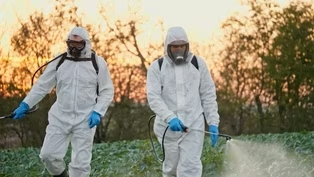
A deadly bat disease, protecting bees and the benefits of waterfalls. Plus, saving oysters. (20s)
Providing Support for PBS.org
Learn Moreabout PBS online sponsorship
- Science and Nature

Miles O'Brien travels the world searching for solutions to today’s most urgent challenges.

 New Episode






 New Episode

Support for PBS provided by:
SCI NC is a local public television program presented by PBS NC
Sci NC is supported by a generous bequest gift from Dan Carrigan and the Gaia Earth-Balance Endowment through the Gaston Community Foundation.