
Trump's national security strategy and how it may play out
Clip: 1/2/2026 | 20m 14sVideo has Closed Captions
Trump's new national security strategy and how it may play out in 2026
President Trump recently released his new national security strategy. It’s a remarkable document that upends many of the principles that have guided U.S. policymaking since the end of World War II. Jeffrey Goldberg and Tom Friedman discuss the new strategy and how it may play out in conflict zones around the world.
Problems playing video? | Closed Captioning Feedback
Problems playing video? | Closed Captioning Feedback
Major funding for “Washington Week with The Atlantic” is provided by Consumer Cellular, Otsuka, Kaiser Permanente, the Yuen Foundation, and the Corporation for Public Broadcasting.
Trump's national security strategy and how it may play out
Clip: 1/2/2026 | 20m 14sVideo has Closed Captions
President Trump recently released his new national security strategy. It’s a remarkable document that upends many of the principles that have guided U.S. policymaking since the end of World War II. Jeffrey Goldberg and Tom Friedman discuss the new strategy and how it may play out in conflict zones around the world.
Problems playing video? | Closed Captioning Feedback
How to Watch Washington Week with The Atlantic
Washington Week with The Atlantic is available to stream on pbs.org and the free PBS App, available on iPhone, Apple TV, Android TV, Android smartphones, Amazon Fire TV, Amazon Fire Tablet, Roku, Samsung Smart TV, and Vizio.
Buy Now
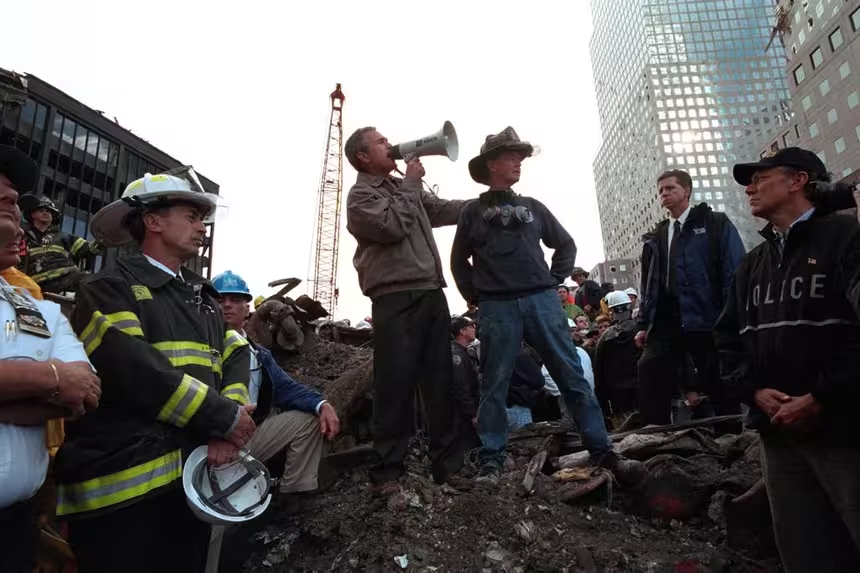
10 big stories Washington Week covered
Washington Week came on the air February 23, 1967. In the 50 years that followed, we covered a lot of history-making events. Read up on 10 of the biggest stories Washington Week covered in its first 50 years.Providing Support for PBS.org
Learn Moreabout PBS online sponsorshipJEFFREY GOLDBERG: President Trump recently released his new national security strategy.
It's a remarkable document, one that upends many of the principles that have guided U.S.
policymaking since the end of World War II.
Tonight, I'll discuss the new strategy and how it may play out in conflict zones around the world with Tom Friedman of The New York Times.
Tom, Happy New Year.
Thank you for being with us.
2026, big year.
THOMAS FRIEDMAN, Foreign Affairs Columnist, The New York Times: Yes.
JEFFREY GOLDBERG: Big year, maybe even bigger than 2025.
There's a lot to talk about.
Let's talk about this national security strategy, which was just released last month in December.
Many people were struck by it.
You were struck, I was struck by the fact that it barely discusses our traditional adversaries, China and Russia, and this has been really flummoxing to a lot of people.
Why does it barely touch on the subject of Russia and China and their role in American foreign policy and talk about what it does talk about?
THOMAS FRIEDMAN: Well, Jeff, I think that document really manifests what a radically different view this administration holds about the world, radical not just from Democrats but from previous Republican administrations.
You and I grew up in a world of both Republican and Democratic leaders who saw the role of the president to be the defender and expander of a world of free markets and free people and the rule of law.
JEFFREY GOLDBERG: Right.
THOMAS FRIEDMAN: And in such a world, Europe, particularly the European Union, was an important pillar and ally.
This group is different.
They see themselves in a global kind of civilizational war, defending the Judeo-Christian world in a world of independent nations not working together in any collaborative way with America being the biggest and therefore having the biggest influence.
JEFFREY GOLDBERG: Right.
THOMAS FRIEDMAN: That's very different from the world that you and I grew up in and that has really been the mission of America up to now.
JEFFREY GOLDBERG: Right.
Let me read you something that you wrote just a few days ago.
He is not, he, Trump, is not interested in refighting the Cold War to defend and expand the frontiers of democracy.
He is, in my view, interested in fighting the civilizational war over what is the American home and what is the European home with an emphasis on race and Christian Judeo faith, and who is an ally in that war and who is not.
Talk about this concept of defense of home.
THOMAS FRIEDMAN: Well, you know, if you ask me, Jeff, what's the biggest question you get traveling around the world today, it's a question that Itamar Ben-Gvir, the far right nationalist leader in Israel, had on his bus ads during the Israeli last election.
And it was just a question that said, who's the landlord here?
Whose country is this anyway?
Because we live in this age of massive migration -- JEFFREY GOLDBERG: Heritage Americans.
THOMAS FRIEDMAN: Yes, exactly.
JEFFREY GOLDBERG: In this context.
THOMAS FRIEDMAN: In our country, that would be it.
JEFFREY GOLDBERG: Right.
THOMAS FRIEDMAN: We live in this age of massive migration happened very fast.
And, basically, a lot of Americans went to the grocery store sometime in the last 20 years, and the woman at the cash register wasn't wearing a baseball hat.
Then they went into the men's room and there was a woman there.
Then they went to the office and their boss rolled up a robot and it seemed to be studying their job.
People's sense of home, of cultural norms and of work all got disrupted at the same time.
So, people's sense of home, you know, people's sense of rootedness.
My friend, Andy Karsner has the best definition of home and community.
It's a place where people feel connected, protected and respected.
And right now there are a lot of people in America and around the world basically asking whose country is this and when can I feel at home?
JEFFREY GOLDBERG: So, what is the Trump -- within the framework of this national security strategy, what is the particular Trump criticism of our traditional allies in Europe, that they're not protecting their own values, which are our values?
THOMAS FRIEDMAN: Well, he sees them basically as having unrestrained immigration.
JEFFREY GOLDBERG: Right.
THOMAS FRIEDMAN: And particularly in Europe's case, it's from the Muslim world, not from the Hispanic world, as we have in the United States, very different from the Judeo-Christian tradition and being open to a lot of these radical transgender, from Trump's point of view, norms, LGBT.
And that explains why Trump sees Putin as an ally.
He's a white Christian nationalist who hates the LGBT movement and all of the progressive causes.
They see him not in some struggle of east west, but is an ally in the civilization award.
JEFFREY GOLDBERG: Let me just ask you, I mean, this hostility to Europe, France, Germany, Britain, in particular, three pillars of our alliance system.
It is true that Europe has an immigration assimilation problem.
THOMAS FRIEDMAN: Yes.
JEFFREY GOLDBERG: And that it is true that it has a radical Islamist problem.
Well, here's what -- just watch this for a second, because here's what J.D.
Vance had to say, made it very, very clear at the Munich Security Conference.
Let's watch this.
J.D.
VANCE, U.S.
Vice President: The threat that I worry the most about vis-a-vis Europe is not Russia.
It's not China, it's not any other external actor.
And what I worry about is the threat from within, the retreat of Europe from some of its most fundamental values, values shared with the United States of America.
JEFFREY GOLDBERG: Look to give him some credit, to give some credit to the intellectual framework of this, Europeans do have -- European nations have a different understanding of free speech.
THOMAS FRIEDMAN: Yes.
JEFFREY GOLDBERG: Not First Amendment-based, like we have.
They do have this.
They're more secularized than our society is, although we're moving into an unchurched -- in an unchurched direction.
I mean, are they onto something at all or is it just xenophobia masquerading as an intellectual exercise?
THOMAS FRIEDMAN: I think they're onto something in this sense, Jeff, you know, and I felt this in America too.
On the question of immigration, I'm for a really high wall with a very big gate, okay, which is that countries have got to control their borders.
And we know from history when countries get flooded by immigrants, the other in a very rapid way, in a very short period of time.
It upsets people's sense of home.
And Europe, like America, to some degree, lost control of their borders.
JEFFREY GOLDBERG: Did Joe Biden not take that seriously?
THOMAS FRIEDMAN: Not enough.
JEFFREY GOLDBERG: Yes.
THOMAS FRIEDMAN: Not enough.
Under pressure from the left wing of the party, not enough.
And, again, I'm super pro-immigration, but it's got to be done in a way where the people come can become Americans and be really anchored in our society and our values.
And I think so he's not raising an illegitimate point.
Well, I have a problem with them on Europe.
You know, Americans will do anything, Jeff, for the European Union except read about it.
But to my mind, the European Union is one of the greatest inventions of modern man.
Can we please remember the history of Europe?
Like from time of memorial was of wars, family wars, religious wars, sectarian wars.
The last two -- JEFFREY GOLDBERG: Italy was 30 countries.
THOMAS FRIEDMAN: Exactly, that's right.
The last three of which the United States World War I, World War II and the Cold War, we had to send our brothers and sisters over to help quell.
Out of that history, they've created the biggest center of free markets, free people, and the rule of law.
Yes, I think they would tell you, and Brexit was a proof of it, some of the immigration got out of control.
But let's remember, they are our wingman in the world.
We are the blessed generation that lives in the world of two United States, not just one, a United States of Europe and a United States of America.
So, his critique is not illegitimate.
It's not without point.
But when it's presented just this way, as if you guys are often some crazy civilizational jag and we have no interest in you anymore, not appreciating how stable another United States makes our world, that's nuts.
JEFFREY GOLDBERG: You know -- THOMAS FRIEDMAN: Trump sees the European Union, frankly, as like a shopping mall that isn't paying enough rent.
You know, the French baguette shop is not paying enough rent, rather than seeing this whole entity as another giant center of free markets and free people.
JEFFREY GOLDBERG: I have to say though, that even President Obama agreed, he voiced it in a more civilized yes, moderated fashion, but that Europe wasn't paying its fair share of its defense.
THOMAS FRIEDMAN: Yes.
JEFFREY GOLDBERG: To be fair, we kind of walked into a couple of situations here.
On the other hand, for me, the E.U.
corollary, what's a great strategic alliance, NATO, has kept the peace since World War II.
And it seems as if -- well, it doesn't seem as if we've already seen President Trump threaten militarily to NATO allies, Canada and Denmark.
So, talk about the defense framework here and what that means for our understanding of whether we're on Ukraine's side or not.
THOMAS FRIEDMAN: Well, you know, let's sort of really zoom out for a second.
If we go back to 2022, the Russian invasion of Ukraine, and we go to the Hamas-Israel War, what basically was going on was Ukraine was trying to join the west and Israel was trying to join the east.
That is Ukraine was trying to join the European Union.
If Ukraine with, its I think 60 million-some people, really advanced economy, high tech, if Ukraine joins the European Union, we are actually 95 percent to a Europe whole and free.
It would be the greatest expansion of freedom and free markets in Europe since the fall of the Berlin Wall.
Had Israel been able to normalize with Saudi Arabia, it would've been the greatest expansion of the world of inclusion in the Middle East since Camp David.
JEFFREY GOLDBERG: Right.
THOMAS FRIEDMAN: Russia stopped the first and Iran stopped the second, right?
And that's why that war is really important, and what Russia did is bad, and what Hamas did is bad.
It doesn't mean everything Israel did on the other way is good.
I'm not -- we could go into all of that or Ukraine.
But something really big is at stake here.
You know, we take for granted, Jeff, the world you and I were born in.
I was born in '53.
You were born in when?
JEFFREY GOLDBERG: 2004.
THOMAS FRIEDMAN: Yes, I forgot.
I knew.
Yes, right.
JEFFREY GOLDBERG: Yes.
THOMAS FRIEDMAN: We have grown up.
In the most peaceful, prosperous era of world history, like in a really, really, really long time.
You know -- JEFFREY GOLDBERG: Well, this is the thing, the success of NATO creates an assumption that the world is always like this for no particular reason.
THOMAS FRIEDMAN: Exactly.
The world is the way the world is because America was the way America was.
You take that America out of the world, you take an America that no longer believes in the European Union, no longer believes in NATO, no longer believes in being the defender of free markets and free people, and I tell you our kids will grow up in a very different world, and you will miss this one when it's gone.
JEFFREY GOLDBERG: So, here's a 2026 question.
Are we on an inexorable slide toward the dissolution of NATO?
The reason I asked this is because the German chancellor himself just said recently, our partnership with the United States of America, which has long been the reliable guarantor of our security, is changing.
For us Europeans, this means that we must defend and assert our interest even more strongly on our own.
The Europeans, as you know, because you talk to the leaders, they are no longer looking to Washington as a source of stable protection.
Are we heading in one direction or is this something that three, four years from now we'll be sitting around this table saying, what was that about?
That was strange.
Remember when we wanted to date some other people for a few months?
THOMAS FRIEDMAN: I -- if Trump keeps going where he's going, he's going to threaten this.
I do believe the weight and the value and importance of these alliances will even, you know, push him back.
But if we have Trump and then Vance, given his isolationist tendencies, we will live in a less prosperous, any less stable and a much more China-dominated world.
JEFFREY GOLDBERG: Let's go to that.
Why is China not a major player in the national security strategy of the United States anymore?
THOMAS FRIEDMAN: Well, again, it should be.
JEFFREY GOLDBERG: But as Trump sees it.
THOMAS FRIEDMAN: Right?
And the people who write these documents, I don't know where they're coming from.
But China today is a peer military and economic rival of the United States, but different from Russia, at least.
China is in the game.
That is, China has a fundamental economic interest in maintaining the global trading system.
Russia, all they do is export oil.
Like did you -- have you bought a Russian watch lately or a Russian computer or a Russian A.I.
system, you know?
JEFFREY GOLDBERG: Right.
THOMAS FRIEDMAN: That's all they've got.
And that's why Putin is such a disruptor.
Basically, he went from a distributor of wealth early on in his term, to a distributor of dignity, okay?
And distributors of dignity are people who start wars, you know, over national, you know, causes whatever.
So, managing the U.S.-China relationship, I think, is the central foreign policy.
JEFFREY GOLDBERG: It's interesting, you're, in a way, making an argument that the Trump national security team makes, which is that Russia and Ukraine, those are -- that's a sideshow compared to the big issue.
You have Elbridge, Colby, and other people in the Pentagon who are China, China, China, China, and they're saying, we're not going to get bogged down in Ukraine on behalf of Ukraine, in the same way that we shouldn't have gotten bogged down in the Middle East because China's going to eat our lunch.
I mean, it does sound like you're in alignment with a Trump vision.
THOMAS FRIEDMAN: Am I allowed to swear on this show?
JEFFREY GOLDBERG: It's PBS.
THOMAS FRIEDMAN: Okay.
So, I'm sorry.
Because I would say that is something stupid, okay?
Okay.
Why is it?
We are a country of 340 million.
China's a country of 1.3 billion people.
And whatever you think about China, Jeff, you can love him or hate him, these are serious people.
When 1.3 billion serious people are focused on economic growth and military development, the idea that we alone can take them on is utter nonsense.
JEFFREY GOLDBERG: Oh, so you're saying we need to be with Europe so Europe is with us on -- THOMAS FRIEDMAN: Exactly.
That's the only way we can deal with them on trade.
How would you deal -- how would any sane person deal with China on trade?
We'd get all our allies together.
We might even strike a treaty, call it TPP, okay, or the Trans-European, you know, American Trade Agreement.
We all agree on a set of values and rules.
And then we'd sit down with China with real weight as equals.
How would a moron do it?
He'd actually go to war with all our allies at the same time and then threaten China and then discover, oh, you have rare earths that we need that run our entire economy.
Oh my God, nobody told me.
I didn't -- I missed that tweet.
So, the Chinese love this.
Why does China and Russia always vote Trump?
Because they know he can never put together an alliance that can truly contradict -- JEFFREY GOLDBERG: No.
It is interesting that most of the neighbors, most of the countries that touch China, North Korea being the exception, probably the sole exception, would rather be allied with the United States than with China.
So, then this goes to the key question, why is there contempt in the Trump administration for the notion of alliances among democracies?
THOMAS FRIEDMAN: Well, it starts with the fact that the president thinks if you have a trade surplus with me, you are stealing from me, okay?
And since that has nothing to do with economics, it's like a superstition, it's like believing you shouldn't have a black cat, you know, across your path, all right, when you start there, then you can't look at someone as a potential ally.
And what the president believes on tariffs is simply wrong.
There is no economist in the Milky Way Galaxy who believes what his spokesman said -- spokeswoman said that tariffs are a tax cut, okay?
There's no one who believes his view on balance of trade.
It's all crazy, all right?
And that's why if you look at all the stories last month, because I've been doing a column on this, the number of small business people who are just up in arm.
They completely can't plan.
They can't import whatever.
And so if everything is a transaction, if you know the price of everything and the value of nothing, which is Donald Trump, okay, then you don't appreciate how these countries can be allies with.
Jeff, they -- did countries take advantages of after World War II, you know, when we stood as star of the world (ph)?
Yes, there's no question.
But we were the world's biggest economy and we had a growing economy because we were the biggest.
We benefited from all of the stability.
JEFFREY GOLDBERG: We were half the world's economy at '45.
THOMAS FRIEDMAN: And could we have done more sharing the pie inside trade insurance for people who got disrupted by trade?
Absolutely, we should have.
But the idea that you overturn this whole system, for what?
JEFFREY GOLDBERG: Right.
The interesting thing -- one of the interesting things about this Trump strategy document are the words Trump strategy, right?
Because this is not a person -- we have this experience with consistent thoughts and application of thoughts.
And it's very interesting that your paper just ran a terrific piece by Adam Entous on the buildup or the last year of the Trump management of the Ukraine file, and he wrote this.
I just think it's a very smart observation.
Mr.
Trump had scant ideological commitment.
His pronouncement and determinations were often shaped by the last person he spoke to by how much respect he felt the Ukrainian and Russian leaders had shown him, and by what caught his eye on Fox News.
So, this is an interesting -- there's an interesting dissonance here.
On the one hand, Donald Trump is not somebody with fixed ideology, right?
On the other hand, he's issuing, or his administration is issuing a national strategy document that's very fixed, in its view.
So, do you think that the strategy document, you just wrote a column about it, actually doesn't matter that much because what matters is what Trump thinks on any given Tuesday?
THOMAS FRIEDMAN: I'm going to confess something on your show, Jeff.
I have no sources in this administration.
Because having sources in this administration other than the president would be dangerous.
Because whatever they tell you, if you then write a column or a news story about it, Trump can go absolutely 180 degrees the opposite the next day on Twitter or on Truth Social.
So, it's all him.
There's no process.
There's no deputies committee.
Look how they've changed tariffs, one day farmers, one day not, up, down.
It's all seat of the pants with everyone running around the bush -- JEFFREY GOLDBERG: Are you saying it's not 4D chess?
THOMAS FRIEDMAN: Right.
It's -- no, actually, it's Russian roulette with a loaded pistol, okay?
That's -- JEFFREY GOLDBERG: Every chamber is loaded?
THOMAS FRIEDMAN: Exactly right.
That's what it is, okay?
JEFFREY GOLDBERG: Right.
THOMAS FRIEDMAN: And so there's no consistency at all, you know?
And -- JEFFREY GOLDBERG: Not to be devil's advocate about everything, but isn't that the lack of consistency, doesn't that keep countries like Iran and North Korea off balance, at least, we don't know what he's going to do.
And, you know, you can't think of many Democrats who scare authoritarian adversaries, like Iran or North Korea.
Doesn't this at least?
THOMAS FRIEDMAN: Absolutely.
And if you harness that, if you focus it, as the president did in bringing about the ceasefire in Gaza, which I gave him effusive praise, because I think only he could have done it.
JEFFREY GOLDBERG: Right.
THOMAS FRIEDMAN: because he was the only one who was ready to bring real leverage on Israel and real leverage on Hamas.
When he's focused like that, he can do it.
But compare that to Ukraine.
He brings super leverage on Ukraine, but nothing on Putin.
JEFFREY GOLDBERG: Right.
THOMAS FRIEDMAN: And one of the great mysteries here, I've never bought into the Russia, you know, owns Trump, that Putin owns Trump, I never bought into any of those things.
But when you don't buy into any of those things, Jeff, you're just left with one of two things.
One is he's a complete dupe for Putin.
And the other, you know, which is worse, is that he actually likes Putin more and his values than he does Ukraine and Zelenskyy.
JEFFREY GOLDBERG: Do you think he has core values?
THOMAS FRIEDMAN: I think he's a purely transactional person on most issues, but not on this one.
It's very strange.
He keeps -- he was ready to bring leverage on Netanyahu, okay, and on Hamas, but he's never been ready to bring leverage on Putin.
Would somebody please explain why?
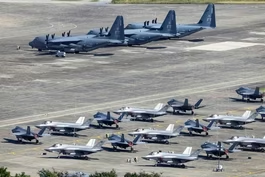
Will Trump go to war with Venezuela in 2026?
Video has Closed Captions
Will Trump go to war with Venezuela in 2026? (3m 26s)
Providing Support for PBS.org
Learn Moreabout PBS online sponsorship
- News and Public Affairs

Top journalists deliver compelling original analysis of the hour's headlines.

- News and Public Affairs

FRONTLINE is investigative journalism that questions, explains and changes our world.











Support for PBS provided by:
Major funding for “Washington Week with The Atlantic” is provided by Consumer Cellular, Otsuka, Kaiser Permanente, the Yuen Foundation, and the Corporation for Public Broadcasting.