
Brooks and Capehart on chances of peace in Ukraine
Clip: 1/2/2026 | 12m 22sVideo has Closed Captions
Brooks and Capehart on chances of Ukraine-Russia talks leading to peace in 2026
New York Times columnist David Brooks and Jonathan Capehart of MS NOW join Amna Nawaz to discuss the week in politics, including if Russia's invasion of Ukraine will end in 2026, President Trump issuing the first vetoes of his second term and their political predictions for the year.
Problems playing video? | Closed Captioning Feedback
Problems playing video? | Closed Captioning Feedback
Major corporate funding for the PBS News Hour is provided by BDO, BNSF, Consumer Cellular, American Cruise Lines, and Raymond James. Funding for the PBS NewsHour Weekend is provided by...
Brooks and Capehart on chances of peace in Ukraine
Clip: 1/2/2026 | 12m 22sVideo has Closed Captions
New York Times columnist David Brooks and Jonathan Capehart of MS NOW join Amna Nawaz to discuss the week in politics, including if Russia's invasion of Ukraine will end in 2026, President Trump issuing the first vetoes of his second term and their political predictions for the year.
Problems playing video? | Closed Captioning Feedback
How to Watch PBS News Hour
PBS News Hour is available to stream on pbs.org and the free PBS App, available on iPhone, Apple TV, Android TV, Android smartphones, Amazon Fire TV, Amazon Fire Tablet, Roku, Samsung Smart TV, and Vizio.
Providing Support for PBS.org
Learn Moreabout PBS online sponsorshipAMNA NAWAZ: 2026 is expected to be an# eventful year, both at home and abroad.
For more on what's ahead and to# look at this past week of news,## we turn now to the analysis of# Brooks and Capehart.
That is New## York Times columnist David Brooks# and Jonathan Capehart of MS NOW.
Great to see you both.
JONATHAN CAPEHART: Happy new year.
AMNA NAWAZ: Happy new year.
DAVID BROOKS: Same.. AMNA NAWAZ: All right, let's# kick this of.. the ongoing Russian war in Ukraine.
We# have seen a lot of headlines this.. and I need to start there because that war# is about to mark four years in February.
We saw the new year begin with a massive# Russian drone barrage in Ukraine,## hundreds of strikes in that country.
We# saw President Zelenskyy and President## Trump meet at Mar-a-Lago last weekend,# say there's progress on a peace plan.
This week, we saw special envoy Steve# Witkoff continue to hold calls with## Zelenskyy and other European officials.# And in his own New Year's address,## Zelenskyy said that the peace# plan is 90 percent ready.
So, David, when you take all# of this and you look ahead,## do you see progress being made?
Is# 2026 the year that the war ends?
DAVID BROOKS: Possibly, but# I'm -- color me skeptical.
I mean, this is the year we will find out# whether the international community can## respond with -- effectively when one nation# tries to conquer another.
And, unfortunately,## what the Trump administration has done recently# has been pressuring Zelenskyy to make concessions,## slow-walking the weapons we have been providing# for them, putting him in a tough position.
He makes some concessions.
And then,# in theory, we give him, in turn,## security guarantees.
And it's supposed# to be like Article 5 of the NATO treaty,## security guarantees of some# number of years, 15 or 20 or 30.
AMNA NAWAZ: Article 5, an attack# on one is an attack on all.
DAVID BROOKS: Yes, attack on -- if the -- if Putin# attacks Ukraine, then we'r.. AMNA NAWAZ: Right.
DAVID BROOKS: Th.. troops or airports -- or airplanes, well, I'd# ask you to talk to people who've done business## with Donald Trump before, because he will# break that.
That is a purposeless guarantee.
And Putin didn't like the way NATO was stretching# eastward anyway.
Why would he accept Ukraine## to have an effective NATO guarantee?
He will# not accept this.
One of the things that it's## reminding people of is, at the end of the Clinton# term, the second Clinton term, he really wanted## to have a peace with Israel and Palestine,# which was absolutely the right thing to do.
But Yasser Arafat was never interested# because he didn't think Israel was a country.## Vladimir Putin does not think Ukraine is# a country.
And so you can't argue people## into a peace they do not want to have.
So I'm# extremely dubious that this is going to work.
AMNA NAWAZ: Jonathan, are you any more# optimistic about what's ahead in this year?
JONATHAN CAPEHART: No, especially picking# up on something David just talked about,## that you said at the very beginning# about the international community## being able to help Ukraine, or I can't# remember exactly what you thought.
But I immediately wrote down, how does the# international community, and particularly the## Europeans, how do they respond to all of this# and come to Ukraine's aid without an effective## partner in the United States, without an effective# partner in the president of the United States?
To David's point, Donald Trump, President Trump,# is not the most reliable negotiator.
If he tells## you at 9:00 that this is the deal, by 9:15,# it could be something completely different.## And so, in the end, I will be keeping my eye on# whether the Europeans can stand on their own,## and on their own in a way that can effectively# help Ukraine without any kind of solid## commitments or assistance from the United States.
AMNA NAWAZ: When you step back and# look at this war for just a moment,## because there's been a lot of questions about# to whom President Trump has been listening,## right -- he changes his tack based on# the last phone call he had, it appears,## sometimes, and also the amount of influence that# President Putin clearly has over the process.
Is there credit to be given to# the White House here, David,## at least for keeping talks going, for keeping# some kind of process on some sort of rails?
Is## that something they should be given credit for?
DAVID BROOKS: Yes, I think they# really want peace.
I think Trump## genuinely wants peace.
And I think he's# obtuse about who Vladimir Putin is.
I think, as we saw in the Oval# Office months and months ago,## he's morally uninvolved in the# stakes of this contest.
Like,## Zelenskyy is a democratically elected leader# whose country was invaded.
And he just doesn't## seem like there's one side that's kind# of on the side of right in this war.
But I do think they have tried hard.
I do think# all the envoys, Jared Kushner, all these guys,## Witkoff, all these people who've been# there are probably sincerely motivated.## I just don't think you can have# peace with Vladimir Putin.
And so,## to me, it's a characterological# misdiagnosis of who this person is.
JONATHAN CAPEHART: I just wonder if President# Trump really wants peace or surrender,## or is there a distinction?
Does he# see a distinction between the two?
AMNA NAWAZ: In terms of what# Ukraine is willing to concede to?
JONATHAN CAPEHART: Right, or -- no, what he wants.
I mean, David just said, they're really# pushing hard for peace.
And, sure,## but at what cost?
Does it require# -- would peace require surrender## on Ukraine's part of territory already# taken by Putin, taken by the Russians... AMNA NAWAZ: Yes.
JONATHAN CAPEHAR.. Ukraine would have to take in# order for there to be peace?
AMNA NAWAZ: They say the plan's 90 percent# there.
We will see in the weeks and months ahead.
I do want to turn to some of the political# pressures President Trump has been managing## here at home as well, because he did issue# his first two vetoes of his second term this## week.
Both are bills, we should point out,# that passed Congress unanimously.
One was## funding a clean water pipeline in Colorado,# the other protected tribal land in Florida.
And you have probably seen# there have been some lawmakers,## including Republican Colorado# Congresswoman Lauren Boebert,## who suggested that the vetoes could have been# some kind of political retaliation.
She was one## of the only Republicans to sign a petition that# forced a vote on releasing the Epstein files.
And a very strong Trump ally, a former elections# clerk official in Colorado, is still in prison## in her state, in Colorado, convicted of state# crime, so his federal pardon does not apply.
Jonathan, I will come to you first on# this.
Do you believe the president is## vetoing unrelated bills for political retribution?
JONATHAN CAPEHART: Gee.
Yes.
(LAUGHTER) JONATHAN CAPEHART: Yes, I do.
From the reporting I saw, this -- the bill# that he vetoed, that water project, $555,000,## so not even a drop in the bucket of federal# spending.
But, also, let's not forget that## Congresswoman Boebert was that one member# of Congress back in November who was called## to the White House Situation Room and talked to# about her signature on that discharge petition.
She left and said, no, I'm still -- I'm not# removing my name, I'm still doing this.
So... AMNA NAWAZ: That was the petition# to release the Epstein files.
JONATHAN CAPEHART: To release -- yes, I'm# sorry.
Yes, to release.. AMNA NAWAZ: Yes.
Yes.
JONATHAN CAPEHAR.. could I not view that as retaliation?
How# could she not view that as retaliation,## even though she asked the question rhetorically?
AMNA NAWAZ: David, what do you make of this?
DAVID BROOKS: One thing I like about# Dona.. (LAUGHTER) DAVID BROOKS: It's n.. In the other case, the Florida case,# it was extending rights to a tribe of## Native Americans whose name I will# now will not try to pronounce.
But## he said it out loud.
He said, this group of# people has opposed my immigration policies.
AMNA NAWAZ: Yes.
DAVID BROOKS: An.. And so it's not only retribution,# though.
It's the cash register.## How do you get people to give you money so you can# have Lee Greenwood perform at the Kennedy Center,## for example?
It's you give them, people# who give what you -- who do what you want,## you give them reward.
People who don't# do what you want, you punish them.
So you have to have the cards# and leverage.
So it's not only## retribution.
It's about leverage.
It's# about doing things not only in this regard,## but in all sorts of regards, that will# punish people who oppose Trump policies.
AMNA NAWAZ: Well, what about Congress' role?# These were unanimous bills in Congress.## Do you see Republicans moving# to override those vetoes, David?
DAVID BROOKS: Again, I have been waiting.
I# mean, we have seen some profiles in courage## microscopically around the Republican# Party, but not so much in Washington.
(LAUGHTER) DAVID BROOKS: There have been a few cases.
AMNA NAWAZ: Yes.
DAVID BROOKS: An.. are Marjorie Taylor Greene and Lauren# Boebert.
These are the hardcore.
Like,## they are out there doing what they want# to do.
And God bless them, I guess.
But I don't see this getting... AMNA NAWAZ: Jonathan?
JONATHAN CAPEHART: Congres.. Trump took the oath of office.
So I don't see# Congress doing anything to roll this back.
And,## if they do, great, I would love for them to prove# me wrong, Speaker Johnson, if you're watching.
AMNA NAWAZ: Well, look, it's our first# time getting to sit down and chat in## 2026, which promises to be a very, very busy year.
I'm going to ask a very dangerous# question, which is whether either## of you care to look ahead and make a bit# of a prediction in terms of what's ahead## in terms of the big stories you think# we will be paying most attention to or## one we don't even see coming around the# corner just yet.
Who wants to go first?
JONATHAN CAPEHART: Jump ball.
Go, David.
(LAUGHTER) DAVID BROOKS: No, you go first.
JONATHAN CAPEHART: Oh, my wo.. Look, I am a perennial optimist.
We are# rolling into a midterm election year where## my optimism demands that I see a future where# Democrats retake the House, suddenly turn the## engine of the Article I powers of the House# back on with oversight and accountability,## that -- finally doing things to# not just rein in this president,## but to also exercise their powers# as a co-equal branch of government.
That is what I'm looking forward to# in this year.
And also I'm looking## forward to the American people making their# voices heard at the ballot box in November,## but throughout the weeks and months ahead# as things happen in their communities and## in their states that they like or don't like# and take to the streets and make sure that## people are watching and people know that they# either like or don't like what's happening.
AMNA NAWAZ: David?
DAVID BROOKS: Yes, I.. out what the A.I.
effect does on the labor# markets.
It'll be the ye.. why China is beating the world in industry# after industry and what are the effects of that.
I agree with Jonathan, the Democrats will# agree to take the House.
But I would say the## thing I'm most interested in and most excited# about is that 2025 was a pretty bad year for## those of us who sit around talking about# politics, but it was OK for the economy.## The last quarter three growth rate was 4.3# percent, but socially it was a very good year.
So we saw suicide deaths down.
We saw violent# crimes down.
We see opioid addiction down.## We see obesity down.
We see social isolation# down, social media use down.
So a lot of the## damage that happened to the fabric of# American society over the last 10 years,## people are beginning to respond, and# they're beginning to figure stuff out.
So longevity was going down.
Now longevity is# going back up again.
And so I think America## is socially healing.
And those are# the things you can extrapolate from,## because those trends are not just blips.
Those# trends, I think, are longstanding.
And we could## see 2026 as a year of more political# depression.
Don't get too cheered up.
(LAUGHTER) JONATHAN CAPEHART: No, I was going to say.
DAVID BROOKS: Bu.. AMNA NAWAZ: Here's to a little# more social healing for us all.
David Brooks, Jonathan# Capehart, thank you to you both.
JONATHAN CAPEHART: Thanks, Amna.
DAVID BROOKS: Thank you.
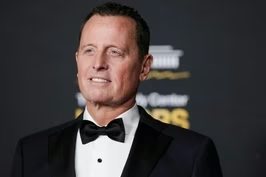
Grenell defends Trump's Kennedy Center takeover
Video has Closed Captions
Clip: 1/2/2026 | 11m 12s | 'We cannot have art institutions that lose money': Grenell defends Kennedy Center takeover (11m 12s)
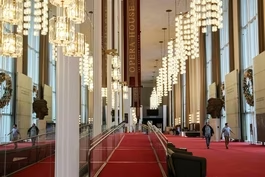
Kennedy Center faces cancellations after Trump's name added
Video has Closed Captions
Clip: 1/2/2026 | 6m 50s | Kennedy Center faces artist cancellations, drop in ticket sales after Trump's name added (6m 50s)

News Wrap: Investigators say sparklers started deadly fire
Video has Closed Captions
Clip: 1/2/2026 | 5m 42s | News Wrap: Swiss investigators believe sparklers started deadly fire inside ski resort bar (5m 42s)
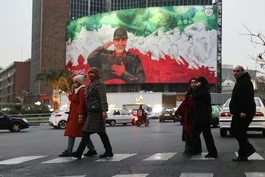
Trump threatens to intervene if Iran kills protesters
Video has Closed Captions
Clip: 1/2/2026 | 8m 35s | Trump threatens to intervene in Iran if regime continues to kill protesters (8m 35s)
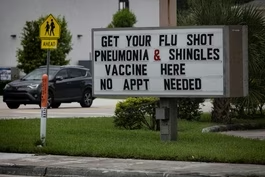
Why the flu season is bad and how you can protect yourself
Video has Closed Captions
Clip: 1/2/2026 | 7m 29s | Why the flu season is so bad and how you can protect yourself (7m 29s)
Providing Support for PBS.org
Learn Moreabout PBS online sponsorship
- News and Public Affairs

FRONTLINE is investigative journalism that questions, explains and changes our world.

- News and Public Affairs

Today's top journalists discuss Washington's current political events and public affairs.










Support for PBS provided by:
Major corporate funding for the PBS News Hour is provided by BDO, BNSF, Consumer Cellular, American Cruise Lines, and Raymond James. Funding for the PBS NewsHour Weekend is provided by...